

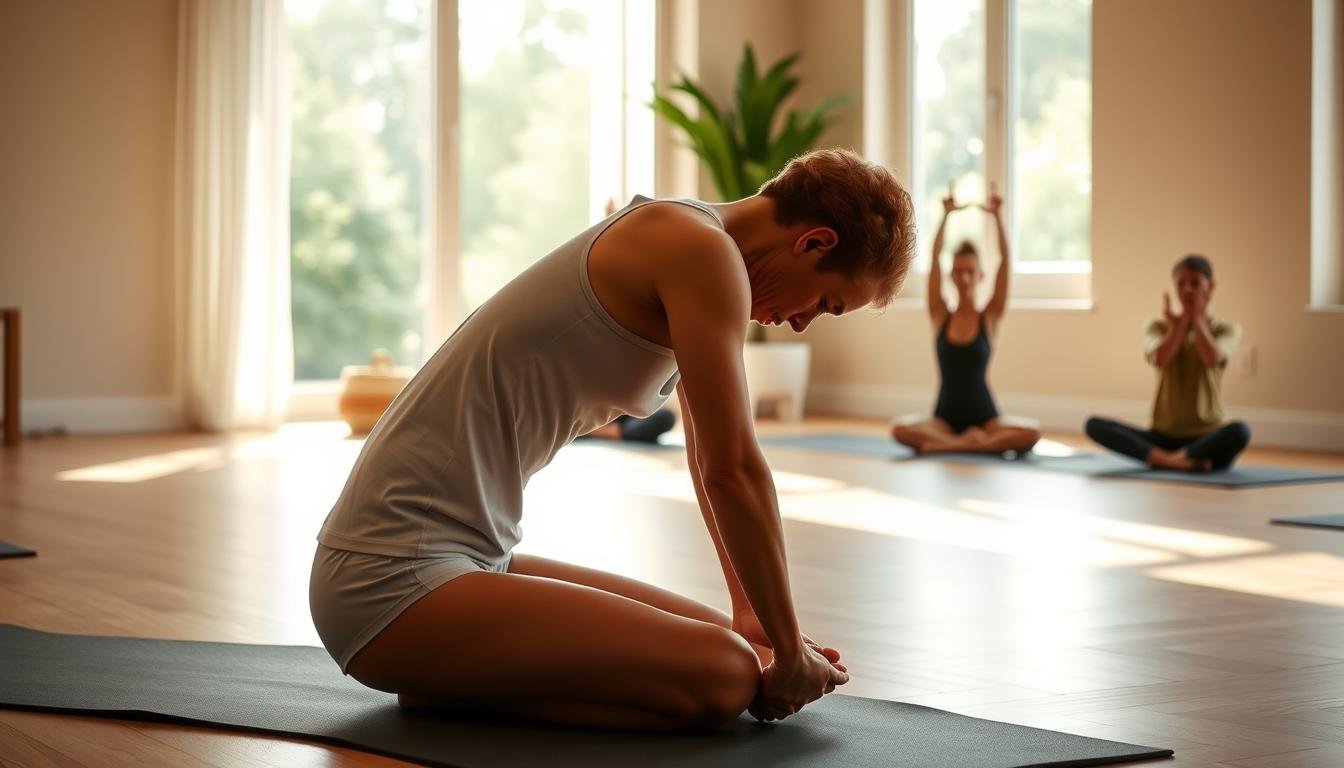
“The greatest wealth is health.” – Virgil
I used to wake up every morning dreading the first movement. My back would scream at me before my feet even touched the floor. Simple tasks like playing with my kids or sitting through a work meeting became battles I didn’t always win.
If you’re reading this, you probably understand that struggle. Americans spend about $135 billion each year on healthcare related to lower back discomfort, and 80% of adults experience it at some point. I was part of that statistic until I discovered something that changed everything.
Research shows that yoga for chronic pain can reduce intensity by 1.5 to 2.3 points on a 0-10 scale after 12-24 weeks of regular practice. This isn’t about miracle cures or overnight transformations. It’s about sustainable, evidence-based pain management techniques that address both physical and emotional aspects of living with discomfort.
In this article, I’ll share specific poses, breathing methods, scientific research, and safety guidelines that helped me reclaim my life. Let’s explore whether this ancient practice might be your answer too.
Key Takeaways
- Regular practice can reduce discomfort intensity by up to 2.3 points on a 10-point scale within 12-24 weeks
- Americans spend $135 billion annually on lower back issues, affecting 80% of adults
- This approach addresses both physical symptoms and emotional components of living with discomfort
- Evidence-based methods combine specific poses with breathing techniques for sustainable relief
- The practice offers a holistic alternative to traditional treatment options without quick-fix promises
🌟 Why I Turned to Yoga for Chronic Pain After Years of Suffering
Trying yoga for chronic pain was a last resort. I had tried everything my doctors suggested. My body felt trapped, and I lost hope.
Chronic pain became a constant companion, affecting every decision. I share my story to show you’re not alone in your pain.
My Decade-Long Battle with Chronic Pain
Pain started ten years ago with what seemed like a simple injury. It spread to my lower back and hips, causing constant pain. Some days were better, but most were not.
Mornings were the hardest. Waking up felt like my body was solid. Getting out of bed took twenty minutes of careful movements.
My social life disappeared. I canceled plans because sitting triggered pain. I stopped going to concerts and family gatherings.
The emotional pain was worse than the physical. Chronic low back pain affects 20% of adults worldwide. I felt like I was part of an invisible club.
Depression slowly crept in. I missed being active and playing with family. My career suffered as I couldn’t focus at work.
Friends and family meant well, but their advice was often hurtful. They suggested basic remedies I’d already tried. This made me feel isolated.
The Limitations of Traditional Pain Management Techniques
I visited my doctor often, trying different treatments. Physical therapy provided temporary relief, but the pain always came back. The exercises helped for a moment but didn’t solve the problem.
Pain medications were a complicated relationship. Anti-inflammatory drugs upset my stomach. Muscle relaxants made me too tired to work.
My doctor suggested stronger drugs, but I was scared of addiction. I’d heard stories of people getting trapped in pain management.
Cortisone injections offered hope at first. The first one gave me three months of less pain. But later injections didn’t help as much.
Traditional treatments often don’t work well and can have bad side effects. My doctors talked about surgery, which scared me.
The cycle was endless:
- Schedule appointment with specialist
- Try new treatment with optimism
- Experience brief improvement
- Watch pain return
- Feel disappointment and frustration
- Repeat
I spent a lot of money and time in waiting rooms. Each failed treatment made me lose hope. I wondered if living in pain was my new reality.
The Moment I Discovered Therapeutic Yoga Practices
The turning point came when I read about therapeutic yoga practices for chronic pain. I was skeptical at first, thinking yoga was too gentle for my pain.
I almost closed the browser, but something kept me reading. The stories of people finding relief through yoga were similar to mine. These weren’t fitness enthusiasts; they were people in pain like me.
I was worried my body could do yoga. I imagined people in impossible poses, something I couldn’t even dream of. The thought of trying and failing was overwhelming.
A friend mentioned she’d tried therapeutic yoga after her car accident. She talked about gentle movements and supportive instructors. Her experience sounded different from the yoga I’d imagined.
The body benefits from movement, and the mind benefits from being calm.
I decided to learn more about yoga for chronic pain. I found out it was different from regular yoga. It focused on gentle movements and healing, not perfection.
After two weeks of research, I contacted a certified yoga therapist. She listened to my story without judgment. She said many of her students were skeptical and hurting, just like me.
I scheduled my first session with hope and fear. I expected disappointment, but a small voice inside hoped it would be different. That hope was enough to get me to try.
🧘 Understanding the Connection Between Yoga for Chronic Pain and Healing
Learning how yoga works on a physical level changed my pain management approach. For years, I practiced without understanding why some movements relieved pain while meds just hid it. Once I grasped the science, I could work with my body smarter and see better results.
The link between yoga for chronic pain and real healing is deep. It involves your nervous system, muscles, and even how your cells handle inflammation. Let me explain the amazing ways this ancient practice helps with today’s pain.
How Movement Therapy Affects Your Nervous System
My chronic pain had created “pain pathways” in my nervous system. These are like neural highways that get better at sending pain signals over time. The more these pathways are used, the stronger they get.
Movement therapy through yoga interrupts these patterns. It introduces new sensory info that competes with pain messages. This idea, called “gate control theory,” has changed how I see pain management.
The best part about yoga is how it activates your parasympathetic nervous system. This is your body’s natural way to relax. Chronic pain keeps us stuck in fight-or-flight mode, where stress hormones make pain worse. Regular yoga practice rewires your brain, creating new pathways that don’t focus on pain.
I saw changes in just three weeks of consistent practice. My body stopped tensing up when I expected movement. This nervous system training was a key part of my healing journey.
The Role of Gentle Yoga Poses in Breaking Pain Cycles
Chronic pain creates a cycle: pain causes muscle guarding, leading to stiffness and more pain. I was stuck in this loop for years before finding how gentle yoga poses could break it.
Poses like Cat-Cow help with controlled spinal mobility. They encourage movement in stiff areas. The gentle rocking motion tells your brain that movement is safe, reducing muscle tension that causes pain.
Child’s Pose became my safe space during flare-ups. It offers physical relief and psychological safety. Your body sees the folded position as safe, calming your nervous system.
What makes gentle yoga poses work is their sub-threshold approach. Unlike aggressive stretching, these movements stay within your comfort zone. I learned to work at about 60-70% of my maximum range, allowing my body to adapt without resistance.
- Sustained holds: Positions held for 3-5 minutes allow fascia and connective tissue to release gradually
- Mindful transitions: Moving slowly between poses maintains nervous system calm and prevents pain spikes
- Proprioceptive awareness: Focusing on body position improves spatial awareness and coordination
- Progressive adaptation: Small incremental changes compound over time without overwhelming your system
The key insight I gained was that gentle yoga poses work with your body’s natural healing mechanisms. This patient approach delivered results that aggressive treatments never did.
Why Yoga Succeeds Where Other Treatments Fall Short
After trying many treatments, I realized why yoga for chronic pain worked where others failed. Traditional medical approaches usually target just one aspect of pain—meds for symptoms, physical therapy for injuries, and psychological support for emotions.
Yoga’s genius is its comprehensive, integrated approach. A single session addresses physical tension, breathing, nervous system regulation, and mental state. This holistic method matches the complex nature of chronic pain, which is never just physical or psychological.
Most conventional treatments make you a passive recipient. You take a pill, get an injection, or have something done to you. Yoga made me an active participant in my healing. This empowerment changed my relationship with pain from helpless victim to informed manager.
The Inflammation-Reduction Effect
One of the most remarkable discoveries in recent pain research is yoga’s impact on inflammation. Studies show that regular practice lowers inflammatory markers like C-reactive protein and interleukin-6 in the blood.
Unlike meds that just suppress symptoms, movement therapy tackles the root causes. When I practice yoga, I stimulate circulation, support lymphatic drainage, and trigger cellular repair. My body produces its own anti-inflammatory compounds through these natural processes.
I noticed this effect most clearly in how my morning stiffness decreased. Within two months of regular practice, I woke up with noticeably less joint inflammation. Blood tests confirmed what I felt—my inflammatory markers had dropped significantly.
| Healing Mechanism | How Yoga Activates It | Timeline for Results |
|---|---|---|
| Inflammation Reduction | Improved circulation and lymphatic flow | 4-8 weeks of consistent practice |
| Nervous System Regulation | Parasympathetic activation through breathwork | Immediate effect, cumulative over 2-3 weeks |
| Fascia Release | Sustained stretches and mindful movement | 6-12 weeks for significant tissue changes |
| Neural Pathway Rewiring | Repeated safe movement patterns | 3-6 months for neuroplastic changes |
Muscle Tension Release and Fascia Health
Before yoga, I didn’t understand fascia—the connective tissue web that surrounds every muscle, organ, and structure in your body. When fascia becomes restricted through injury, stress, or chronic tension, it can create widespread pain that seems to have no clear source.
Gentle yoga poses work on fascial release through sustained, low-intensity stretches. Unlike quick stretches that mainly affect muscles, holding poses for several minutes allows fascia to lengthen and release restrictions.
I experienced this most profoundly in my hip flexors and lower back. Years of sitting had created fascial adhesions that pulled my posture out of alignment. Yin yoga poses targeting these areas literally changed the texture of my tissues over time—they went from feeling like tight leather to supple and mobile.
Traditional physical therapy often misses this fascial component because it focuses on muscular strength and joint mobility. The slow, mindful approach of yoga addresses the fascial system in ways that more aggressive therapies cannot. This fascial health improvement contributed significantly to my long-term pain reduction.
Understanding these mechanisms gave me confidence that I wasn’t just managing symptoms—I was actually healing the underlying causes of my chronic pain. This knowledge kept me motivated through the early weeks when progress felt slow, knowing that profound changes were happening at cellular and neural levels.
🔬 Scientific Evidence Supporting Yoga for Chronic Pain Relief
The research on yoga for chronic pain convinced me to give it a try. I needed to see real evidence before trying a new treatment. After years of failed therapies, I wasn’t ready to try another approach without proof.
What I found amazed me. Major medical institutions published solid studies showing pain improvements. These weren’t small surveys or anecdotal reports—they were rigorous clinical trials.
What Clinical Studies Reveal About Yoga and Pain Management
The Cleveland Clinic study changed everything for me. Researchers recruited 140 healthcare employees with chronic low back pain. They divided them into two groups.
One group started a 12-week virtual hatha yoga program. The other group waited without treatment.
The results were remarkable. After 12 weeks, yoga participants reported an average pain reduction of 1.5 points. But after 24 weeks, that reduction extended to 2.3 points.
This means many participants went from pain levels around 6 out of 10 down to 3 or 4. That’s a big difference.
Even better, 34% fewer yoga participants used pain medication compared to the control group. At the start, 74% of people were taking pain medications regularly. After six months, less than one-third of the yoga group needed medication, while more than half of the wait-list group continued relying on drugs.
“While anti-inflammatory medication addresses physical symptoms, yoga has the capacity to also address emotional and social components of pain while reinforcing one’s meaning and purpose.”
This quote resonated deeply with me. My pain affected every part of my life—not just my body, but my relationships, my mood, and my sense of identity. Traditional medications only numbed the physical sensation without addressing these other dimensions.
A 2021 Cochrane review examined multiple studies on yoga for chronic low back pain. While the quality of individual studies varied, numerous trials demonstrated clear benefits for both pain relief and improved daily function. This systematic review gave me even more confidence that the Cleveland Clinic results weren’t a fluke.
Research on Yoga for Fibromyalgia Patients
When I looked into yoga for fibromyalgia, I found encouraging data. Fibromyalgia creates widespread chronic pain throughout the body, making it one of the most challenging conditions to treat.
Studies on yoga for fibromyalgia showed improvements across multiple symptoms. Participants reported not just reduced pain levels, but also less fatigue, better sleep quality, and improved mood. These are exactly the issues that make fibromyalgia so debilitating.
One thing that stood out was how yoga addressed the pain hypersensitivity common in fibromyalgia. The gentle movements and mindful awareness seemed to retrain the nervous system’s pain response. This made sense to me because my own body had become overly sensitive to sensations that shouldn’t be painful.
Researchers noted that consistent practice over several weeks produced the best outcomes. Quick fixes didn’t work, but gradual, sustained engagement with therapeutic yoga practices created lasting changes. This aligned with my experience—the benefits built over time.
Long-Term Benefits Documented by Medical Researchers
What impressed me most about the scientific evidence was the sustainability of results. Many pain treatments provide temporary relief but lose effectiveness over time. The research on yoga showed something different.
The Cleveland Clinic study tracked participants at 24 weeks and found that improvements in pain and back-related function were sustained at that six-month mark. In fact, the benefits had actually increased compared to the 12-week measurements.
This told me that yoga wasn’t just masking symptoms—it was creating real physiological changes. My body was learning new movement patterns, my nervous system was recalibrating, and these changes persisted because they were fundamental.
Medical researchers emphasized that yoga works on multiple levels simultaneously. It improves flexibility and strength, reduces inflammation, balances the autonomic nervous system, and changes how the brain processes pain signals. This multi-dimensional approach explained why the benefits lasted while single-mechanism treatments eventually failed.
Stanford University’s Pain Management Studies
Stanford’s research on mind-body practices for pain management reinforced what I was learning. Their studies examined how practices like yoga, tai chi, and meditation affect the central nervous system’s pain processing mechanisms.
The Stanford researchers found that regular practice actually changes brain activity patterns in regions associated with pain perception. Areas that were hyperactive in chronic pain patients showed reduced activation after consistent yoga practice. While regions involved in emotional regulation and cognitive control became more active.
This wasn’t just about distraction or positive thinking. The brain was literally rewiring itself through repeated practice. Understanding this mechanism gave me patience when results didn’t come immediately—I knew my nervous system needed time to create new pathways.
National Institutes of Health Findings
The NIH has invested significant resources into researching yoga for chronic pain. Their position statement provided important validation: they consider yoga generally safe for healthy people when performed properly under qualified instruction.
This safety profile was critical for me. Many pain treatments carry serious risks—surgery complications, medication side effects, invasive procedures. Knowing that the NIH endorsed yoga as a low-risk intervention made me feel more comfortable trying it.
The NIH research also highlighted that yoga works best as part of a broader pain management approach. It wasn’t about replacing all other treatments, but adding a powerful tool that addressed aspects of pain other interventions missed.
Their findings aligned perfectly with my experience. I didn’t abandon medical care—I enhanced it with yoga. The combination proved far more effective than either approach alone. The scientific evidence gave me confidence that this integrated strategy was sound.
💚 Five Therapeutic Yoga Practices That Transform Chronic Pain
Finding the right yoga practice for your pain level is key. Not every class will work for you, and that’s okay. Therapeutic yoga offers many styles, each helping in different ways.
I’ve tried many yoga styles over the years. Some made me feel worse, but others helped a lot. The five practices I share here have helped me a lot with my pain.
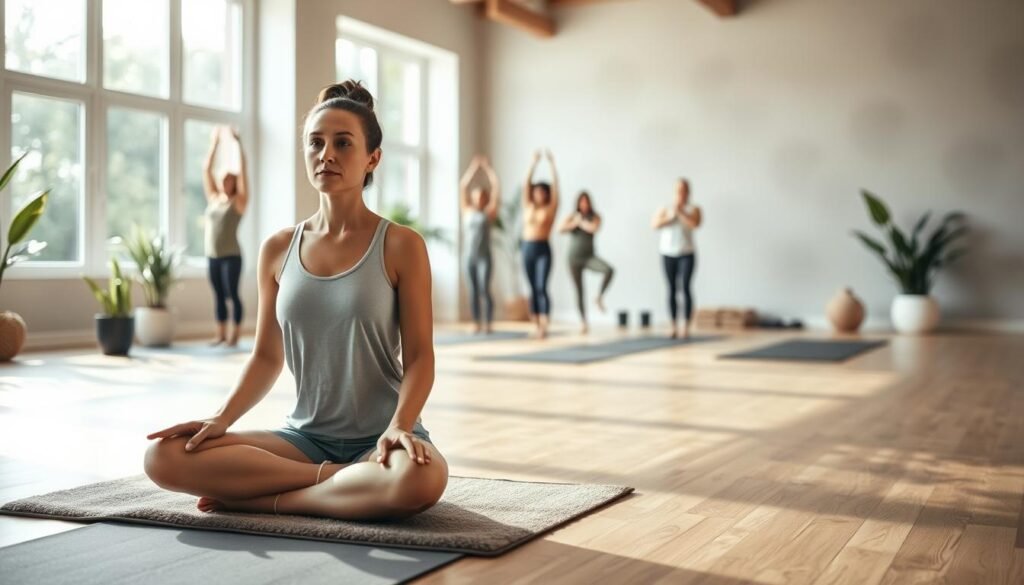
1. Restorative Yoga Benefits for Deep Healing
Restorative yoga was a lifesaver on tough days. It uses props to support your body in gentle poses for 5 to 20 minutes.
This practice helps you relax deeply. It activates your body’s healing system, reducing pain. My first class was amazing, and I felt tension melt away.
Restorative yoga benefits go beyond just relaxing. It shows that healing can happen without effort. On bad days, it helped me practice without pain.
2. Hatha Yoga for Gentle Strength Building
Hatha yoga is great for building strength slowly. It’s studied for helping with chronic back pain. It combines poses with breathing to strengthen without overdoing it.
I love Hatha yoga for its slow pace. It lets you focus on proper alignment and listen to your body. Each pose is a chance to find support and avoid strain.
Regular practice made a big difference. I could move easier, and my core got stronger. Hatha yoga shows that gentle effort is more effective than pushing through pain.
3. Yin Yoga for Connective Tissue Release
Yin yoga targets deep layers of pain in your body. It uses passive stretches for 3 to 5 minutes per pose. This is different from more active yoga styles.
My first Yin pose was uncomfortable, but it was releasing tension. After weeks, tight areas started to soften. Yin yoga helps with restrictions that other methods can’t reach.
4. Adaptive Yoga Methods for Every Body Type
Adaptive yoga changed my view of yoga. It’s designed for people with chronic pain, adapting poses to fit your needs.
Adaptive yoga is flexible, allowing you to practice anywhere. You can do it in bed, on the floor, or even while traveling. There’s no one “right” way to do a pose.
I found great resources at www.healthyvibeslife.com for adapting poses. They show how to modify poses for different pain conditions. This helped me avoid unnecessary pain during practice.
5. Chair Yoga for Severe Pain Days
Chair yoga was a game-changer for me. It lets you do yoga without getting on the floor, perfect for bad pain days.
Every yoga pose has a chair version. You can stretch, strengthen, and breathe while seated. This made it easy to keep practicing even when I was in a lot of pain.
I have a folding chair in my bedroom for these days. Doing modified poses from a chair helped me stay active. Chair yoga shows that some movement is always better than none.
The www.healthyvibeslife.com newsletter showed me quick sequences to do in 10 minutes. These short practices helped me stay connected to my body during pain flares.
Each of these five approaches offers something special for your healing journey. Try them all and see which one works best for you. You might find that different styles work better on different days, creating a flexible toolkit for your pain.
🧘♀️ Eight Gentle Yoga Poses I Use Daily for Pain Relief
These eight poses are more than exercises; they’re my daily tools for managing chronic pain. I picked each one for its effectiveness during both good and bad days. They require little effort but offer a lot of relief.
I practice these poses almost every morning and sometimes in the evening when pain spikes. Their adaptability lets me adjust them based on my body’s needs. This flexibility has made yoga a compassionate daily ritual for me.
Remember, these movements should never cause sharp pain. If you feel discomfort, stop or skip the pose. Listen to your body’s feedback.
1. Child’s Pose (Balasana) for Lower Back Comfort
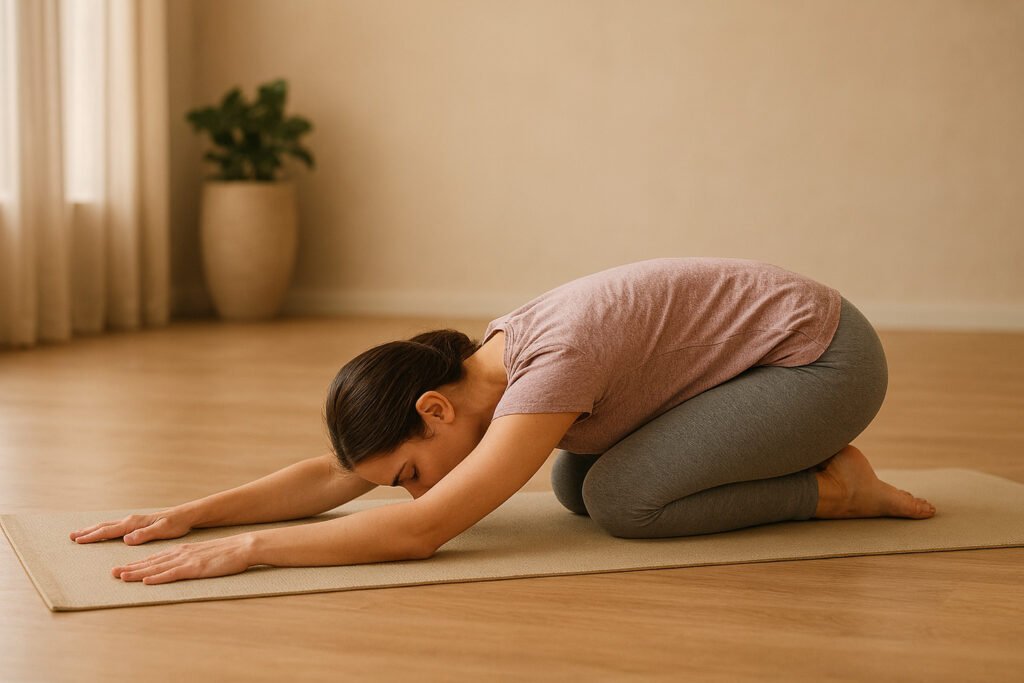
Child’s Pose is my go-to for pain relief. It stretches the lower back, hips, and thighs. It also brings a sense of calm and safety.
This pose has a big psychological benefit too. When pain feels overwhelming, it helps me reconnect with my breath and calm my nervous system.
To start, kneel on your mat with your big toes together and knees apart. Sit back toward your heels and extend your arms forward. Rest your forehead on the mat.
If your hips can’t reach your heels, use a folded blanket or pillow for support. For tight hips, widen your knees. You can also use a bolster or pillows under your torso for a deeper stretch.
For knee discomfort, add extra padding or a towel behind your knees. Sometimes, I keep my arms by my sides instead of reaching forward. This feels less vulnerable.
Duration and Breathing Pattern
I hold Child’s Pose for 1 to 5 minutes, depending on my body’s needs. Focus on slow, deep breaths that expand into your back body.
I breathe in for 4-6 counts and out for 6-8 counts. This activates my parasympathetic nervous system, reducing pain perception. On tough days, I spend up to ten minutes in this pose.
2. Cat-Cow Stretch (Marjaryasana-Bitilasana) for Spinal Mobility
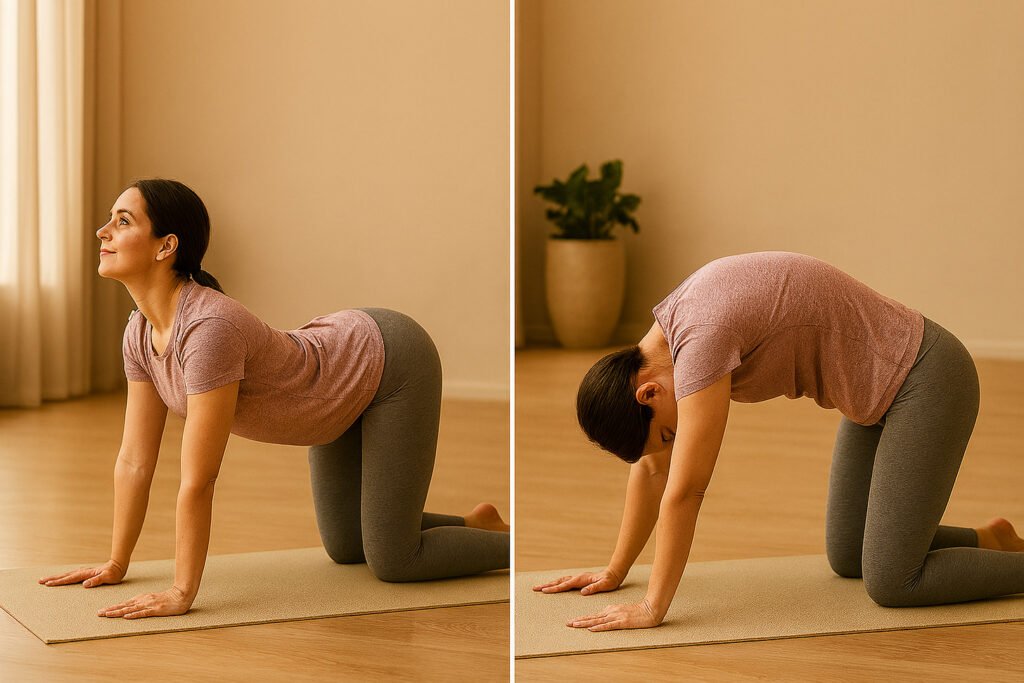
This movement mobilizes your spine, improving circulation and reducing stiffness. It’s a gentle, rhythmic motion that feels like a spine massage.
Start in a tabletop position with your hands and knees. Inhale and drop your belly toward the mat, lifting your chest and tailbone. Exhale and round your spine toward the ceiling, tucking your chin and tailbone.
The key is the coordination between breath and movement. Move slowly, taking at least five seconds for each transition. It’s about gentle, continuous motion that wakes up your spine.
I do 10-15 rounds, but sometimes I do 20-30 rounds if my back is stiff. This pose is great for morning stiffness because it requires no props and can be done beside your bed.
3. Supine Spinal Twist for Hip and Back Release
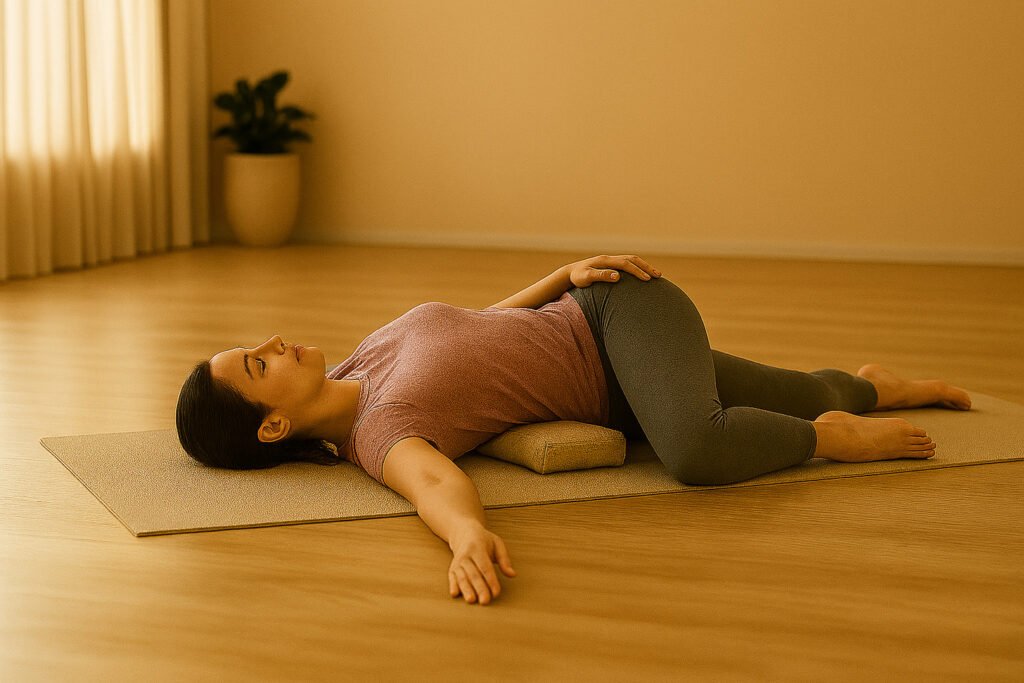
This pose releases tension in your lower back and hips without strain. It’s a gentle twist that stretches your spine and muscles.
Lie on your back and draw your right knee toward your chest. Use your left hand to guide your right knee across your body toward the left side. Keep your right shoulder grounded on the mat.
Place a pillow or bolster under your bent knee for support. Without it, gravity pulls too hard on your lower back. With support, you can relax into the twist without forcing it.
Hold each side for 1-3 minutes, breathing deeply into your ribcage. You might feel releases and pops in your spine. Always move slowly when coming out of twists to avoid jarring your spine.
4. Legs Up the Wall (Viparita Karani) for Circulation
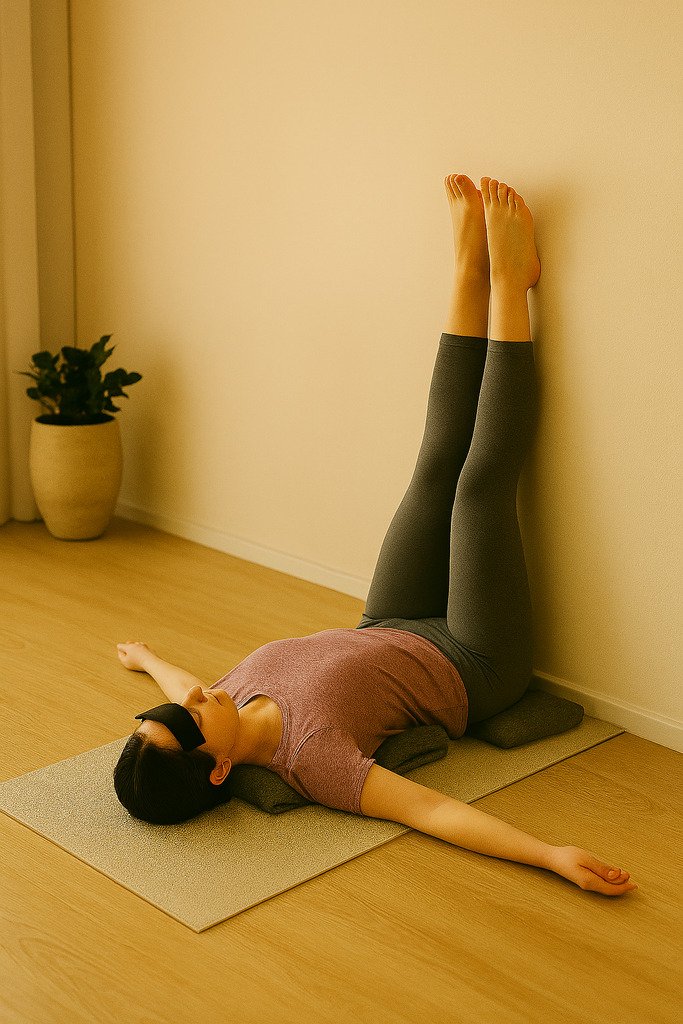
This pose is a rescue for long days of sitting or standing. It reduces swelling in your legs and feet, improves circulation, and calms your nervous system.
Position your mat perpendicular to a wall and sit with one hip against the wall. Swing your legs up the wall as you lie back, scooting your buttocks as close to the wall as comfortable. Your body forms an L-shape with your legs resting against the wall.
For comfort, place a folded blanket or small pillow under your hips for a gentle backbend. You can also use an eye pillow for extra relaxation. If your legs feel strained, bend your knees slightly or move your hips farther from the wall.
I stay in this pose for 5-15 minutes, often before bed. The lymphatic drainage effect reduces inflammation, which impacts pain levels the next day.
5. Supported Bridge Pose for Core Engagement
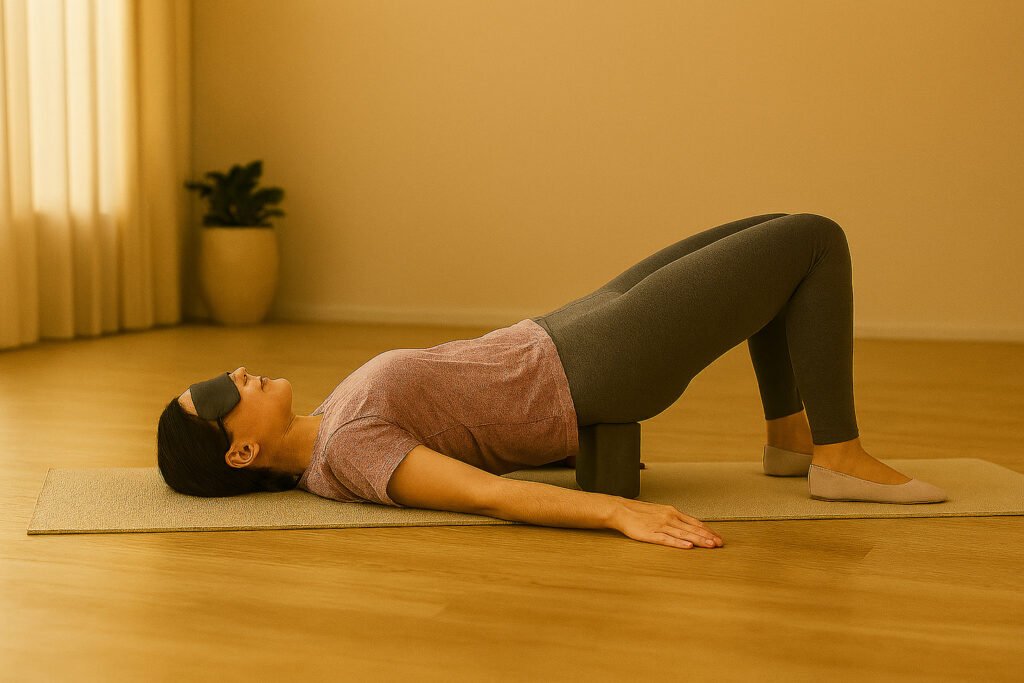
Using a yoga block under your sacrum transforms Bridge Pose into a restorative version. It opens your front body while engaging your core without strain. It also supports circulation and lymphatic flow.
Lie on your back with knees bent and feet flat on the floor, hip-width apart. Lift your hips and slide a yoga block under your sacrum. Start with the block at its lowest height and adjust upward only if comfortable.
Your weight should rest on the block, not on your neck or shoulders. Keep your arms relaxed by your sides or extend them overhead. The pose should feel stable and comfortable—if you’re wobbling or straining, lower the block height.
I hold this for 2-5 minutes, focusing on breathing into my belly. The gentle engagement of my core muscles without active effort helps rebuild strength lost to chronic pain. This pose also stretches the hip flexors, which become tight from prolonged sitting.
6. Reclining Bound Angle Pose (Supta Baddha Konasana)
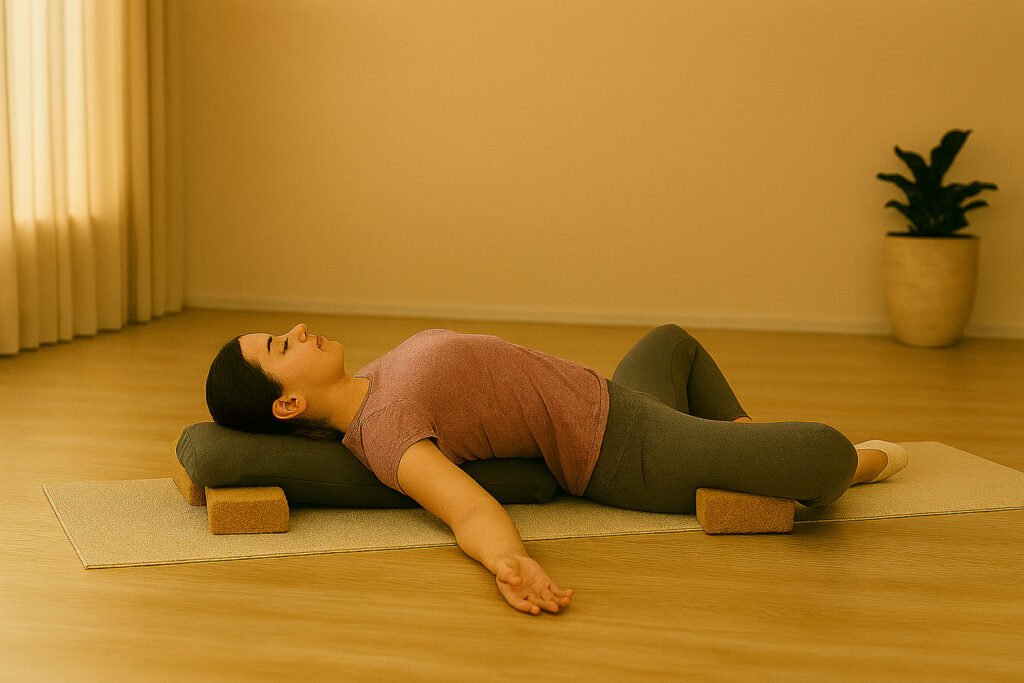
This pose releases tension in your hips, groin, and lower back while promoting deep relaxation. Hip tightness often contributes to back pain, and this pose addresses that beautifully. I use this pose whenever I feel my hips gripping or my lower back compensating for hip immobility.
Lie on your back and bring the soles of your feet together, allowing your knees to fall open to the sides. Use yoga blocks, cushions, or folded blankets under each thigh for support. This is essential for anyone with chronic pain.
You can also place a bolster or folded blankets under your spine from hips to head for additional support. Rest your arms by your sides with palms facing up. The goal is complete surrender, not forcing your knees toward the floor.
I typically hold this pose for 5-10 minutes, sometimes longer when I’m stressed. The combination of hip opening and chest expansion creates emotional release alongside physical relief. Many practitioners report this pose helps them process stored tension and trauma.
7. Seated Forward Fold with Props
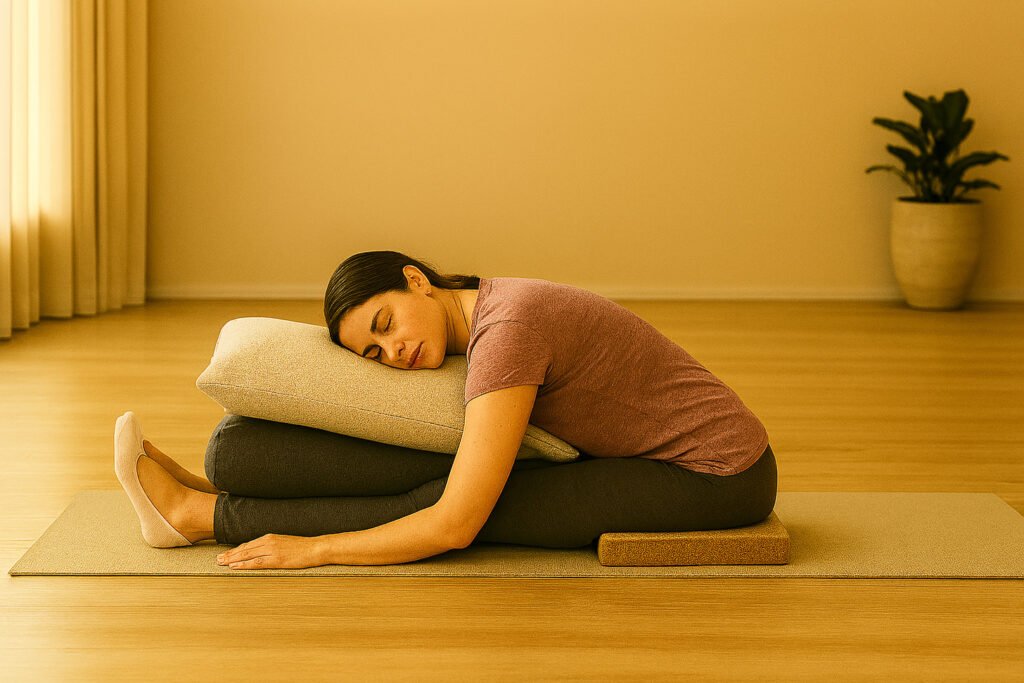
The key to this pose is using props. Unsupported forward folds can strain your back and hamstrings. By placing bolsters or folded blankets on your legs, this pose becomes deeply restorative. This was a game-changer for my practice.
Sit with your legs extended in front of you (or slightly bent if needed). Stack folded blankets, a bolster, or pillows on your thighs until they’re high enough for your torso to rest comfortably when you fold forward. The props should come to you—you shouldn’t have to reach down to them.
Hinge at your hips and rest your torso, arms, and head on the prop support. Turn your head to one side and switch halfway through. This gentle compression on the belly stimulates the vagus nerve, which activates the relaxation response and reduces pain perception.
Hold for 3-5 minutes, breathing naturally. I use this pose when anxiety amplifies my pain, as the forward folding motion is naturally calming. If your hamstrings are tight, sit on a folded blanket to tilt your pelvis forward and reduce strain.
8. Corpse Pose (Savasana) for Complete Integration
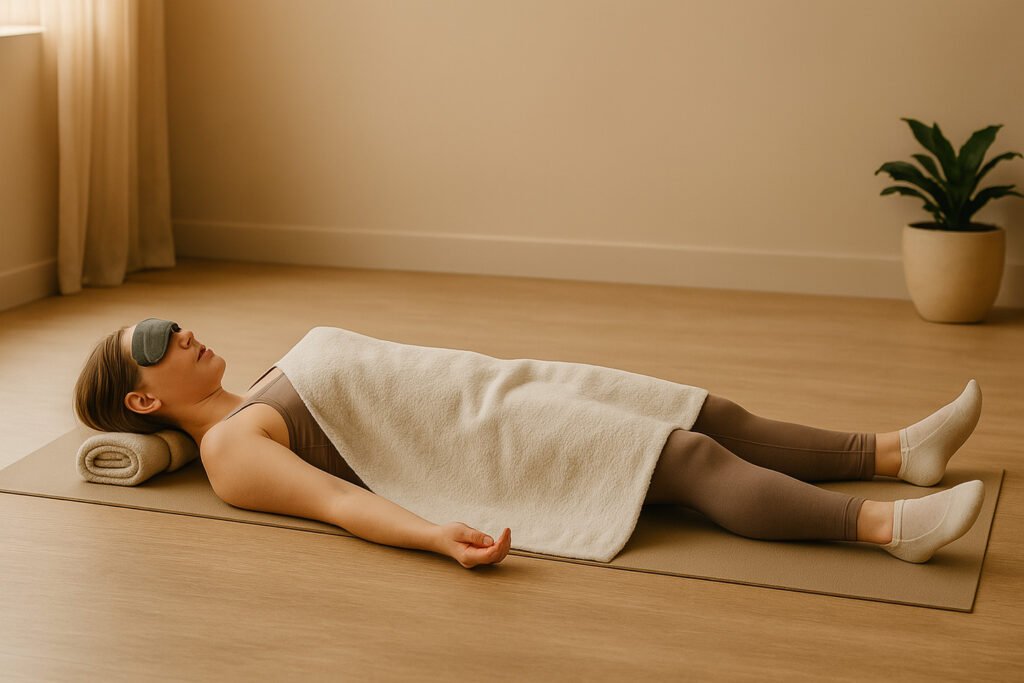
Never skip this final resting pose—it’s when your nervous system integrates all the benefits of your practice. Savasana allows your body to absorb the physiological changes and shift from doing to being. I once thought this pose was optional, but I now consider it the most important part of any yoga for chronic pain session.
Lie flat on your back with legs extended and arms by your sides, palms facing up. Allow your feet to fall open naturally. Place a bolster or several pillows under your knees to release lower back tension completely.
I also place a small rolled towel or thin pillow under my neck if needed, and always use a blanket for warmth. An eye pillow blocks light and adds gentle pressure that calms the nervous system.
Stay in Savasana for at least 5 minutes, ideally 10-15 minutes. Set a gentle timer so you can fully relax without watching the clock. Focus on your breath or use a body scan technique, mentally releasing tension from each body part.
| Pose Name | Primary Benefit | Recommended Duration | Essential Props |
|---|---|---|---|
| Child’s Pose | Lower back relief | 1-5 minutes | Bolster, blankets |
| Cat-Cow Stretch | Spinal mobility | 10-15 rounds | None required |
| Supine Spinal Twist | Hip and back release | 1-3 minutes per side | Pillow for knee support |
| Legs Up the Wall | Circulation improvement | 5-15 minutes | Blanket for hips, eye pillow |
| Supported Bridge Pose | Core engagement | 2-5 minutes | Yoga block |
This sequence of eight poses takes me about 30-40 minutes to complete, though I sometimes do a shorter 15-minute version focusing on just four or five poses. The consistency matters more than the duration. Even on my worst pain days, I can manage a modified version of at least three of these poses.
What transformed my experience wasn’t perfecting these poses but showing up for them daily with compassion and patience. These gentle yoga poses taught me that healing happens in the small, consistent actions we take, not in dramatic breakthroughs. Your body already knows how to heal—these poses simply create the conditions for that natural healing to occur.
I encourage you to visit www.healthyvibeslife.com for video demonstrations of these poses and subscribe to the newsletter for weekly pose tutorials and sequences designed for chronic pain management. Seeing these movements in action can make a significant difference in your understanding and confidence.
🌬️ Breathing Techniques That Enhanced My Yoga for Chronic Pain Practice
I found that my breath was the most powerful tool against pain. It was free and always with me. The poses of yoga for chronic pain helped, but breathing techniques changed everything. They let me find relief anywhere, anytime, without needing anything special.
When pain hit, I couldn’t always do yoga poses. But I could always breathe. Learning to use my breath was a game-changer for me.
Breathwork works fast. Just changing how I breathed made my body relax. My shoulders dropped, my jaw relaxed, and the pain eased.
Diaphragmatic Breathing for Immediate Pain Management
This simple technique, also called belly breathing, was my first defense against pain. It’s easy: I breathe so my belly rises, not my chest.
This breathing turns on your body’s calming system. When in pain, we often breathe shallowly, making pain worse. This cycle is hard to break.
I breathe like this before getting out of bed on tough days. It helps me move with less fear. Deep belly breathing tells your body it’s safe to relax.
Starting with five minutes, I built up my breathing skills. Now, my body breathes this way naturally during stress.
Alternate Nostril Breathing (Nadi Shodhana) for Nervous System Balance
This ancient method was strange at first but became a favorite pain management technique. It involves breathing through one nostril, then the other, in a pattern.
I close one nostril and breathe through the other, then switch. This pattern balances my nervous system and lowers cortisol, reducing inflammation and anxiety.
This became my pre-yoga ritual. It helps me focus on healing. Even without yoga, ten minutes of this breathing can center me.
4-7-8 Breathing for Pain Flare-Ups
This technique, developed by Dr. Andrew Weil, is a lifesaver for pain. It triggers a deep relaxation response that can calm pain quickly.
I use it during severe pain. It doesn’t get rid of the pain but changes how I react to it. I can relax around it instead of tensing up.
Step-by-Step Instructions
The pattern is specific and the timing is key. I exhale fully, then inhale quietly for a count of four. Next, I hold my breath for seven counts, then exhale for eight.
This completes one cycle. I repeat it four times to start, but more is better. Keep the 4-7-8 ratio, adjusting as needed.
Best Times to Practice
Before bed, this technique calms my nervous system. During pain flares, it helps me stay calm. It’s also great before yoga to prepare my body.
I use it before medical appointments or social events to stay centered. Even three rounds can make a big difference.
| Breathing Technique | Primary Benefit | Best Used For | Practice Duration |
|---|---|---|---|
| Diaphragmatic Breathing | Activates parasympathetic nervous system | Daily foundation, morning routine, general pain management | 5-10 minutes daily |
| Alternate Nostril Breathing | Balances nervous system, reduces cortisol | Pre-yoga practice, anxiety relief, transition periods | 5-15 minutes as needed |
| 4-7-8 Breathing | Triggers deep relaxation response | Pain flare-ups, sleep preparation, acute stress | 4-8 cycles per session |
Regular breathwork changed how I deal with pain. I had tools to use right away. No special equipment or place needed, just my breath.
These breathing techniques also improved my yoga. Proper breathing helped me hold poses longer and with less effort. My body trusted me more because I could calm it down.
Breathwork is incredibly portable. I used it during a tough meeting and at the dentist’s without anyone noticing. It’s a powerful tool for managing pain anywhere, anytime.
For more breathing practices, visit www.healthyvibeslife.com. Newsletter subscribers get monthly practices for chronic pain. I also share about wellness retreats where you can learn these techniques in a supportive setting.
Breath became the key to healing from pain. These simple practices, done regularly, brought changes that medicine and physical therapy couldn’t. They gave me control over my pain and showed that the most powerful medicine can come from within.
🧠 How Mindfulness Meditation for Pain Relief Changed Everything
When I started using mindfulness meditation for pain relief every day, my life changed in ways I never expected. Adding mindfulness to my yoga for chronic pain routine changed how I felt about living with pain.
I used to only focus on the physical side of pain. But mindfulness showed me the importance of the mental side too.
Studies show that mindfulness helps with both physical and mental pain. It can improve mood and sleep, helping you heal faster.
Body Scan Meditation During Yoga Practice
Body scan meditation became key for me in every yoga for chronic pain session. It’s about paying attention to each part of your body, noticing what you feel without judgment.
I start by lying down on my mat. I focus on my toes first, just observing what I feel.
Then, I move up my body, paying attention to each part. This includes my feet, ankles, calves, knees, and thighs. I also focus on my hips, lower back, abdomen, chest, and shoulders.
I notice all sensations—tingling, warmth, coolness, tightness, ease. I don’t judge these feelings as good or bad.
I found a surprising truth. By being more aware of pain, it actually feels less intense. When I stop fighting my feelings, I create less tension around them.
This quick body scan helps me see where I’m holding tension. It shows me which areas need gentle care and my overall pain level before I start moving.
Pain is inevitable, but suffering is optional. The difference lies in how we relate to our experience.
Visualization Techniques I Use for Pain Control
Specific images help me when pain gets worse. These mindfulness meditation for pain relief methods change how my brain handles pain signals.
I imagine my breath as healing light in painful areas. With each breath, I feel warmth and comfort spreading.
Sometimes, I picture tension melting like ice in the sun. It goes from hard and frozen to soft and flowing.
In Cat-Cow pose, I see my spine moving freely and fluidly. I imagine each vertebra expanding with each breath.
In forward bends, I picture my muscles relaxing and letting go. They’re like tight rubber bands slowly loosening.
I also use color to visualize pain. When pain feels red and angry, I see it turn to cool blues and greens with each breath.
These practices aren’t just abstract. They’re real tools that change how we feel pain by working different parts of the brain.
Changing My Relationship with Pain Through Awareness
Mindfulness changed how I see my chronic condition. It wasn’t about getting rid of pain—it was about changing how I experience it.
Research shows that a holistic approach affects pain by tackling emotional and social aspects. When I started working on these mental sides, my life improved a lot.
My whole view changed from fighting my body to working with it. This shift felt like a revolution after years of struggle.
The Difference Between Pain and Suffering
I learned a key difference through mindfulness meditation for pain relief. Physical pain is the feeling in my body. Suffering is the story I tell myself about that feeling.
Most of my distress wasn’t from the pain itself. It was from my resistance to it, my fear, and my worries about the future.
I noticed pain felt worse when I worried about it. But when I calmly accepted it, the same pain felt more manageable.
For example, back pain during grocery shopping used to scare me. I’d think, “This is getting worse. I’ll never be able to do normal activities. My life is ruined.”
Now, I feel the same pain and think, “My back hurts right now. I’ll rest when I get home.” The pain feels the same, but my emotional suffering is different.
| Aspect | Before Mindfulness | After Mindfulness Practice |
|---|---|---|
| Pain Flare Response | Panic, tension, catastrophic thinking | Calm observation, gentle adjustment, acceptance |
| Mental State | Constant worry about pain levels | Present-moment awareness without judgment |
| Physical Tension | Bracing and clenching around pain | Softening and creating space around sensation |
| Overall Impact | Pain dominated daily life and mood | Pain exists but doesn’t control my experience |
Acceptance vs. Resistance in Chronic Conditions
Accepting my pain made it less intense and impactful. This was a hard lesson in my yoga for chronic pain journey.
Acceptance doesn’t mean giving up. It means facing reality as it is, right now.
Resistance makes my body tense. When I fight pain, I tense up. This makes pain signals stronger.
Mindfulness taught me to relax around pain instead. I create space for it, not fight it.
This small change had a big impact. My pain levels went down when I stopped adding to the discomfort.
I practice acceptance in every yoga for chronic pain session. If a pose feels hard, I don’t push too hard. I also don’t give up right away.
Instead, I breathe into the feeling. I make small adjustments. I ask if the discomfort is harmful or just challenging.
On tough days, I accept that my practice will be different. Some days I do full sequences. Other days, I just stretch or breathe.
Both are important because I’m listening to my body. This kind approach reduced my frustration and helped me progress faster.
For more guided practices, visit www.healthyvibeslife.com. Newsletter subscribers get monthly meditations for pain management. You’ll also find mindfulness retreats and wellness travel to support your healing.
✨ Seven Life-Changing Benefits of Yoga for Chronic Pain I Never Expected
When I started yoga for my chronic pain, I didn’t know how much it would change my life. I hoped for some relief, like less stiffness and fewer bad days. But what I got was much more amazing.
Yoga didn’t just help my physical pain. It touched every part of my life. These seven benefits changed my life in ways medicine never could.
1. Improved Sleep Quality and Faster Recovery
Chronic pain had taken my sleep for nearly a decade. I woke up four or five times each night, unable to find a comfortable position. Every morning, I felt more exhausted than when I went to bed.
Within three weeks of consistent practice, something shifted. I started sleeping through the night more often. The quality of my rest improved dramatically, and I woke feeling actually refreshed.
Cleveland Clinic research validates my experience—their studies showed yoga practitioners reported significantly better sleep quality compared to control groups. This creates a beautiful positive cycle: better sleep improves pain management, which leads to even better sleep.
My bedtime routine now includes specific poses. Legs Up the Wall for ten minutes calms my nervous system. A brief Savasana with focused breathing prepares my body for rest. These simple practices became more effective than any sleep medication I’d tried.
2. Reduced Dependence on Pain Medications
I never thought I’d reduce my medication use. For years, pills were my only lifeline during difficult days. But as my yoga practice deepened, something remarkable happened.
I noticed I was reaching for medication less frequently. Under my doctor’s supervision, I gradually reduced my dosage. The freedom I felt was indescribable—no more digestive issues, mental fog, or the constant worry about long-term side effects.
Research backs up this experience powerfully. Studies documented that 74% of participants were taking pain medicine at the study’s start. After six months of yoga practice, less than one-third of participants needed medication. That’s a 34% greater reduction compared to control groups who didn’t practice yoga.
I’m not suggesting everyone should stop their medications. But yoga gave me an alternative tool that actually worked. Today, I use medication only occasionally, not daily.
3. Enhanced Mood and Mental Clarity
Chronic pain had dragged me into a dark place mentally. Depression became my constant companion. Anxiety about future pain consumed my thoughts. A thick mental fog made simple tasks feel overwhelming.
Regular yoga practice lifted this heavy cloud. Within two months, I noticed my mood improving. The anxiety that gripped me loosened its hold. My thinking became clearer and sharper.
The science explains why this happens. Movement increases endorphin production—our body’s natural mood elevators. Breathwork reduces stress hormones like cortisol. Mindfulness practices interrupt negative thought patterns before they spiral.
I felt like myself again for the first time in years. My optimism returned, and I could focus on work and relationships without the constant distraction of pain dominating my thoughts.
4. Better Range of Motion and Daily Functioning
Before yoga, simple activities felt impossible. Bending to tie my shoes made me wince. Reaching overhead to grab items from shelves required strategic planning. I couldn’t sit at my desk for more than twenty minutes without shifting positions.
Therapeutic yoga practices gradually restored movements I thought I’d lost forever. The improvements were concrete and life-changing:
- Bending and twisting without pain or hesitation
- Reaching overhead comfortably for everyday tasks
- Sitting through meetings or social events without constant discomfort
- Playing with my nieces and nephews again
- Returning to hobbies like gardening that I’d abandoned
Research confirms these functional improvements. Studies show yoga practitioners could resume activities like sitting for long hours or lifting light objects without the discomfort that previously limited them. Joint range of motion increased measurably across multiple studies.
These weren’t dramatic athletic achievements. They were the ordinary activities that make life worth living. Getting them back was extraordinary.
5. Increased Energy Levels Throughout the Day
This benefit surprised me most. I expected yoga might help my pain, but I worried it would exhaust my already limited energy reserves. The opposite happened.
Gentle movement actually increased my energy throughout the day. I stopped experiencing the afternoon crashes that used to leave me useless after 2 PM. I had stamina for evening activities instead of collapsing on the couch.
The explanation makes sense once you understand the connection. Chronic pain and the constant muscle tension it creates are absolutely exhausting. As both decreased through regular practice, my energy naturally increased.
Yoga also improved my circulation and reduced inflammation—both factors that contribute to fatigue. Combined with better sleep quality, I now have the energy to live my life fully.
6. Stronger Social Connections Through Classes
Chronic pain is isolating. I had withdrawn from social activities because they seemed too difficult. I felt like nobody understood what I was going through. Loneliness became another layer of suffering.
Joining yoga classes—even virtual ones initially—connected me with others who truly understood. I met people navigating similar challenges. We shared not just a practice space but also wisdom, encouragement, and genuine friendship.
These connections provided something medication never could. I found accountability partners who checked in on difficult days. I discovered teachers who adapted poses to my specific needs. I built a community that celebrated my progress and supported me through setbacks.
The social aspect of yoga classes reduced my isolation dramatically. I looked forward to class not just for the physical practice but for the human connection that came with it.
7. Greater Sense of Control Over My Health
Perhaps the most profound benefit was psychological. After years of feeling helpless and dependent on doctors and medications, yoga gave me something powerful—agency over my own healing.
I controlled when I practiced, which poses I chose, and how deeply I worked. I could directly influence my pain levels through my own actions. This wasn’t passive treatment—it was active participation in my recovery.
This restored sense of control transformed my relationship with chronic pain. Instead of feeling like a victim of my condition, I became an active manager of my health. I had hope about my future for the first time in years.
The empowerment extended beyond yoga itself. I became more proactive about other aspects of my health—nutrition, stress management, and preventive care. I reclaimed my life from chronic pain’s grip.
| Unexpected Benefit | Timeline to Notice | Impact Level | Research Support |
|---|---|---|---|
| Improved Sleep Quality | 3-4 weeks | High | Cleveland Clinic studies |
| Reduced Medication Use | 2-6 months | Very High | 34% greater reduction documented |
| Enhanced Mental Clarity | 6-8 weeks | High | Multiple mood improvement studies |
| Better Range of Motion | 4-8 weeks | Very High | Functional improvement research |
| Increased Energy Levels | 3-6 weeks | Moderate to High | Fatigue reduction studies |
These seven benefits transformed my life beyond pain relief. They gave me back the person I thought chronic pain had taken away permanently. If you’re struggling with persistent pain, I encourage you to explore more success stories and detailed wellness guides at www.healthyvibeslife.com.
I highly recommend subscribing to the newsletter for weekly inspiration and practical yoga sequences. You’ll receive exclusive content about wellness travel opportunities to healing retreats, honest reviews of the latest yoga props and pain management products, and special deals on wellness services that support your healing journey.
The unexpected benefits of yoga for chronic pain continue to unfold in my life. Each month brings new improvements I never anticipated. Your journey will be unique, but I’m confident you’ll discover your own unexpected gifts through consistent, compassionate practice.
⚠️ Essential Safety Guidelines for Practicing Yoga for Chronic Pain
Learning to practice yoga safely was key for me during my chronic pain journey. Yoga for chronic pain is very beneficial, but it’s important to do it right to avoid injuries.
I learned this the hard way in my first month. I pushed too hard in a pose and had a three-day flare-up. This taught me that safety is about being smart, not scared.
The National Institutes of Health say yoga is safe for healthy people when done right. But, they warn that injuries can happen, like with any exercise, and more so for older adults.
Why Working with Certified Yoga Therapists Matters
Finding the right teacher was a game-changer for me. Not all yoga teachers know how to handle pain management. This is very important when you have chronic conditions.
Yoga therapists are different from regular yoga teachers. They get extra training in anatomy and working with health issues. This helps them adjust poses for your specific needs.
When I started with a certified yoga therapist, I noticed a big difference. She asked me lots of questions about my pain and health before we started.
- C-IAYT certification from the International Association of Yoga Therapists
- Specific experience working with chronic pain conditions
- Willingness to offer a private consultation session initially
- Knowledge of anatomy and common pain conditions
- References from other chronic pain students
Finding a qualified teacher is hard, but it’s worth the search. The right teacher can make a big difference in your healing.
Ask for a quick phone call before signing up for classes. Talk about their training, experience with your condition, and how they modify poses. Their answers will show if they’re right for you.
Recognizing Helpful Discomfort vs. Harmful Pain
Knowing the difference between good stretching and bad pain is tricky. It took me a few months to get it right.
Good discomfort feels like a gentle stretch. It’s not too bad, usually between 3 and 5 on a pain scale. You can breathe and relax into it.
Bad pain is sharp or makes you tense up. It’s usually over 5 or 6 on the pain scale.
Dr. Saper says to listen to your body. If you feel pain, stop or ask for changes right away.
If you feel pain, come out of the pose or ask for variations.
I follow the rule of “backing off the edge” in my practice. If I hit my limit in a pose, I step back a bit. This keeps me safe without losing the benefits.
A study found that some people had temporary pain flares from yoga. This shows that even gentle practices can have risks, making proper teaching very important.
When to Consult Your Healthcare Provider First
Some conditions need a doctor’s okay before starting yoga. Getting approval from your doctor keeps you safe.
Dr. Saper says to check with your doctor about yoga for chronic pain. He suggests only taking classes made for people with chronic pain.
Seek medical clearance if you have:
- Recent surgery or acute injuries
- Severe osteoporosis
- Uncontrolled high blood pressure
- Recent heart attack or stroke
- Pregnancy with complications
- Any condition your doctor says limits certain movements
Bring research on yoga for chronic pain to your doctor’s appointment. Many doctors like patients who research and talk about it openly.
I brought studies on yoga for chronic pain to my doctor before starting. This helped my doctor understand my goals and give me specific advice.
Even with your doctor’s okay, starting with a qualified teacher is key. They can give you the right attention and changes to keep your practice safe and effective.
For more safety tips and specific guidance, visit www.healthyvibeslife.com. Newsletter subscribers get monthly safety tips, yoga research updates, and info on working with qualified teachers.
🚀 My Step-by-Step Guide to Starting Yoga for Chronic Pain Today
Starting yoga for chronic pain can be overwhelming. I felt the same way when I first began. Here is a guide to help you avoid common mistakes and start with confidence.
You don’t need to be flexible or pain-free to start. All you need is a willingness to try something new and commit to your healing journey.
Finding Qualified Instructors Who Understand Pain Management Techniques
Finding the right instructor is key. I found mine through a hospital wellness program, which greatly helped my recovery.
Start by visiting IAYT.org, the International Association of Yoga Therapists. They have a directory of certified professionals trained in therapeutic yoga. These instructors know how to modify poses for different conditions and understand the difference between good discomfort and bad pain.
Look for classes labeled as “gentle,” “therapeutic,” “restorative,” or “adaptive.” These classes are slower and focus on making poses work for you, not perfecting them.
Read instructor bios before joining a class. Look for mentions of chronic pain experience, specialized training, or certifications beyond basic yoga. Don’t hesitate to ask for a brief phone call to discuss your needs.
Virtual classes have made it easier to find qualified instructors. A study by the Cleveland Clinic showed that 60-minute live-streamed classes each week, along with independent practice, significantly improved chronic pain sufferers. Virtual classes remove barriers like transportation costs and location limits while providing the benefits of live instruction.
Research confirms that virtual yoga offers many benefits similar to live classes, making it a great option for those facing barriers to in-person classes.
Ask your healthcare provider or pain management clinic for referrals. Many medical professionals now recognize yoga’s therapeutic value and keep lists of trusted instructors in their communities.
Essential Props That Make Practice Accessible
The right props made my practice accessible. At first, I tried poses without support, which only made my pain worse. Props are tools that make poses safer and more effective for bodies with chronic pain.
Bolsters, Blocks, and Straps
Bolsters are firm cushions that support your body in restorative poses. They make poses like Supported Child’s Pose or Reclining Bound Angle comfortable for several minutes, allowing deep release.
Blocks bring the floor closer to you. In poses like Triangle or Seated Forward Fold, blocks prevent overstretching while building strength gradually. I use mine daily and consider them essential for safe practice.
Straps are fabric bands that extend your reach when flexibility is limited. They’re helpful in Seated Forward Fold or Reclining Hand-to-Big-Toe Pose, allowing you to maintain proper alignment without strain.
The Cleveland Clinic participants received mats and materials explaining proper prop use. Research shows that proper instruction in using supportive props like blocks and chairs is key for adapting poses to individual skill levels and pain conditions.
Budget-Friendly Alternatives
I started with household items before buying yoga props. This kept costs down while I decided if yoga for chronic pain was right for me.
- Instead of bolsters: Use firm bed pillows or tightly rolled blankets secured with rubber bands
- Instead of blocks: Stack thick hardcover books to the height you need
- Instead of straps: Use a bathrobe tie, regular belt, or even a long scarf
- Instead of a mat: Practice on a large towel or folded blanket on carpet
These substitutions work well and show that starting yoga doesn’t require a big investment. Focus on the practice itself, not perfect equipment.
Setting Realistic Expectations for Your First 30 Days
Knowing what to expect in your first month helps avoid discouragement. I wish someone had prepared me for starting a therapeutic yoga practice.
Your first sessions might feel awkward or increase discomfort awareness. This is because you’re reconnecting with your body after years of guarding against pain. The heightened awareness is actually a sign of progress, not failure.
Real improvements take time. The Cleveland Clinic study showed initial results at 6 weeks, with more significant improvements at 12 and 24 weeks. This timeline reflects my own experience—small shifts in the first month that built into substantial changes over several months.
| Timeline | What to Expect | Signs of Progress |
|---|---|---|
| Week 1-2 | Learning basic poses, feeling awkward, increased body awareness | Completing short sessions, understanding prop use |
| Week 3-4 | Building consistency, noticing subtle changes in flexibility | Reduced morning stiffness, improved breathing patterns |
| Week 5-8 | Developing personal practice preferences, occasional frustration | Better pain days becoming more frequent, enhanced mood |
| Week 9-12 | Establishing sustainable routine, recognizing pain patterns | Measurable improvements in function and quality of life |
Progress isn’t linear. Some days will feel better than others, and that’s completely normal. The goal isn’t achieving perfect poses but experiencing gradual improvements in pain levels, daily functioning, and overall quality of life.
I had days during my first month when getting on the mat felt impossible. I also had moments of unexpected relief that kept me motivated. Both experiences are valid parts of the healing journey.
Creating a Sustainable Home Practice Routine
Consistency matters more than duration when starting yoga for chronic pain. I learned this after trying ambitious hour-long practices that I couldn’t maintain. Building a sustainable routine requires strategic planning and realistic goals.
Best Times to Practice for Pain Relief
Morning practice reduces stiffness accumulated during sleep and sets a positive tone for your day. I do 10-15 minutes of gentle stretching every morning, and it dramatically impacts how my body feels throughout the day.
Midday practice breaks up long periods of sitting or standing. Even five minutes of movement can prevent pain from escalating during your workday.
Evening practice releases accumulated tension and prepares your body for restorative sleep. Gentle poses before bed improved my sleep quality more than any medication I tried.
During pain flares might seem counterintuitive, but gentle practice when discomfort spikes can actually provide relief. I use modified poses and breathing exercises during flares instead of complete rest.
Starting with Just 10 Minutes Daily
The Cleveland Clinic participants practiced at least 30 minutes daily in addition to weekly classes. But I recommend beginners start much smaller to build sustainable habits.
Choose a consistent time that fits naturally into your existing routine. I started with 10 minutes right after my morning coffee, which created a reliable anchor for the habit.
Begin with just 2-3 poses and breathing exercises. My first routine included only Child’s Pose and Cat-Cow Stretch, along with five minutes of diaphragmatic breathing. This simplicity made it easy to complete every day.
Ten minutes of daily practice provides more benefits than an hour once a week. Consistency builds the neurological and physical changes that reduce chronic pain over time.
Gradually add time and poses as your consistency builds. After two weeks of 10-minute sessions, I extended to 15 minutes. After a month, I was naturally practicing 20-25 minutes because it felt good, not because I forced myself.
Subscribe to the newsletter at www.healthyvibeslife.com to receive weekly practice tips. Subscribers also receive deals on yoga props and wellness products, plus information about wellness travel opportunities including yoga retreats designed for people managing chronic pain.
The newsletter connects you with a supportive community of people on similar healing journeys. This connection made a big difference in keeping me motivated during tough times.
Starting yoga for chronic pain today means taking one small, manageable step. You don’t need to be perfect or pain-free. You simply need to show up for yourself with compassion and consistency. Your future self will thank you for beginning this journey.
🌈 Conclusion
Can yoga really help chronic pain? Absolutely yes. Pain levels drop by half, and medication use goes down by 34%. These benefits last for 24 weeks.
Dr. Saper says we should make yoga more accessible. It’s a safe and effective way to treat pain, unlike some traditional therapies.
My journey from medication to yoga for chronic pain changed my life. It wasn’t quick. It took consistency, proper teaching, and patience. The benefits were more than just pain relief.
I also got better sleep, a better mood, and hope for the future. These changes were life-changing.
If you’re dealing with chronic pain and feel stuck, try yoga.
Starting might seem hard, but just take the first step. Roll out a mat, breathe deeply, and move slowly. You don’t need to be flexible or pain-free. Just show up for yourself with kindness.