
Last summer, I was in a small hotel room in Denver at 6 a.m. I was missing my usual gym time. My schedule was tight, and the hotel gym wouldn’t open for three hours. That morning was a turning point for me.
I learned that staying fit on the road isn’t about doing the same workouts at home. It’s about making the most of any space and time you have.
Millions of travelers face the same challenge every day. Whether it’s for work, vacation, or adventure, it can mess up your exercise routine. But the good news is, you can stay fit while traveling with the right approach.
In this guide, I’ll share practical tips that work anywhere. You’ll learn about bodyweight exercises, portable equipment, and quick workouts. These tips are based on my own experiences traveling constantly.
The key is to focus on maintaining fitness, not just improving it. Studies show that simple bodyweight exercises can keep you strong just like gym workouts.
Key Takeaways
- Maintaining consistency matters more than perfection when exercising away from home
- Bodyweight workouts deliver the same benefits as gym equipment for travelers
- A maintenance mindset helps you stay active without stress or guilt
- Limited space and time don’t have to derail your wellness goals
- Simple equipment-free routines work effectively in any hotel room or small area
- Smart planning transforms travel obstacles into manageable fitness opportunities
💪 My Journey with Staying Active During Travel
For the first five years of my traveling career, I struggled to stay active away from home. I tried to do my gym routine in tiny hotel rooms, but it never worked. Or I’d give up and promise to start again when I got home.
This approach led to a frustrating cycle. Before trips, I worried about losing my fitness gains. During trips, I felt guilty for missing workouts. After returning, I’d spend weeks trying to regain what I’d lost.
Everything changed during a three-week business trip to Chicago. I packed resistance bands but didn’t use them for ten days. On day eleven, I did fifteen minutes of bodyweight exercises in my hotel room.
That short workout changed everything. I slept better that night. My energy improved the next day. Most importantly, I learned that staying active during travel isn’t about being perfect—it’s about being consistent.
Maintenance is easier than progress. A few short, efficient workouts each week can keep you fit for a long time.
After that, I saw travel differently. I started to see trips as chances to maintain my fitness, not as setbacks. This change reduced my stress and made staying active while traveling achievable.
Let me share two examples from my experience:
- The failure: A two-week vacation to Europe where I did zero exercise. I convinced myself I needed a full hour and proper equipment. I returned home tired and had lost strength.
- The success: A ten-day work trip to Seattle where I did 20 minutes of movement each morning. I used bodyweight exercises and walked a lot. I felt energized the whole trip.
The difference wasn’t about time or equipment. It was about my mindset and expectations.
Through trial and error, I found that 15-20 minutes of movement was incredibly beneficial. These short sessions helped me fight jet lag, sleep better, and stay focused for work or exploration.
It’s not about being a fitness fanatic on vacation. It’s about respecting the effort I put into my health at home and not wanting to lose it for a few weeks of travel.
Many travelers fall into the all-or-nothing trap. They think they’ll “just start again when I get home,” not realizing how hard it is to rebuild. I fell into this trap many times before realizing that something is always better than nothing.
Now, my approach to fitness while traveling is based on three key principles:
- Short workouts are valid—15 minutes counts
- Adaptation is better than replication—modify instead of giving up
- Consistency is more important than intensity—frequent workouts matter more than perfect ones
This journey taught me that staying active while traveling doesn’t need special equipment or expensive gym memberships. It requires a willingness to adapt, realistic expectations, and understanding that maintaining fitness is easier than rebuilding it from scratch.
If I can stay fit on the road despite a demanding schedule, tight hotel rooms, and constant time zone changes, anyone can. The strategies I’ll share come from my real-world experience—the mistakes I made, the solutions I found, and the approaches that work no matter where I travel.
🏋️ Essential Bodyweight Exercises for Every Travel Workout
Bodyweight exercises have changed how I stay fit while traveling. They need no equipment and are very effective. I don’t have to find a gym or carry heavy gear.
These exercises are the base of my travel workouts. They work on all major muscle groups and fit any fitness level. Whether you’re new to working out or experienced, these exercises will challenge you right.
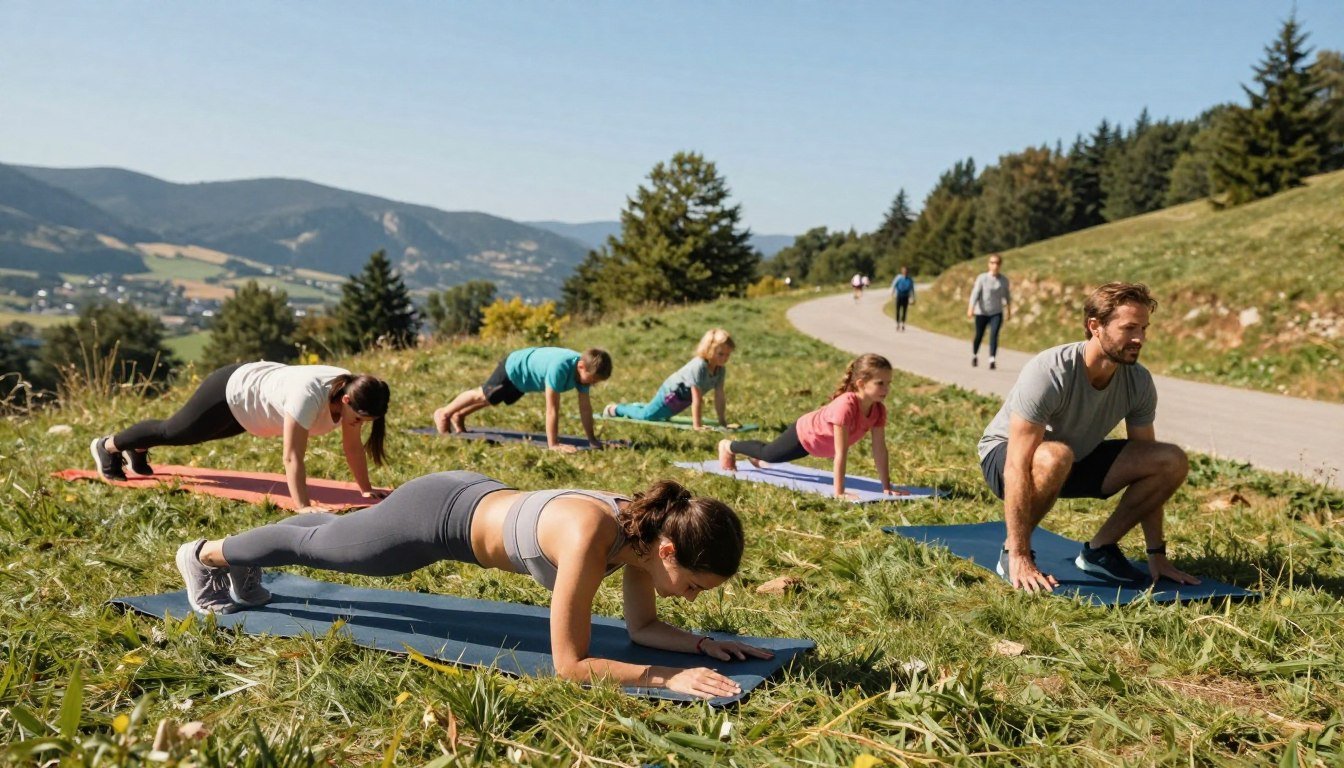
Exercising with bodyweight movements is very versatile. You can do them in a hotel room, at a park, or even in an airport. All you need is a small space and the will to move.
Upper Body Exercises You Can Do Anywhere
Building upper body strength without weights can seem tough. But, bodyweight exercises for travel are just as good as gym workouts. The key is to focus on proper form and increase intensity slowly.
Your upper body includes your chest, shoulders, back, and arms. These muscles help with daily activities. Keeping them strong while traveling keeps you energized and prevents stiffness from long trips.
Standard and Modified Push-Ups
Push-ups are key for upper body training on the go. They work your chest, shoulders, triceps, and core. I do them almost every morning when I’m away.
To do a standard push-up right, start in a plank position. Place your hands wider than shoulder-width apart. Your body should be straight from head to heels.
Lower your chest toward the floor by bending your elbows. Keep them at about a 45-degree angle. Go down until your chest almost touches the floor, then push back up.
Modifications make push-ups accessible for everyone. If standard push-ups are too hard, try incline push-ups. Place your hands on a bed, desk, or counter instead of the floor. The higher the surface, the easier it is.
For more challenge, elevate your feet on a chair or bed. This variation shifts more weight onto your upper chest and shoulders. I use this when hotel room workouts need extra intensity.
Tricep dips target the backs of your arms very effectively. I love this exercise because hotel rooms always have a sturdy chair or bed edge to use.
Sit on the edge of a chair or bed with your hands gripping the edge beside your hips. Slide your bottom forward off the edge. Your legs can be bent with feet flat on the floor for an easier version, or extended straight for more difficulty.
Lower your body by bending your elbows until they reach about 90 degrees. Keep your back close to the chair edge. Then press through your palms to straighten your arms and return to the starting position.
Shoulder positioning is critical for safety. Keep your shoulders down and back throughout the movement. Don’t let them hunch up toward your ears. This protects your shoulder joints and keeps the focus on your triceps.
Arm Circles and Shoulder Taps
These dynamic movements are great warm-ups before more intense exercises. They also build shoulder stability and endurance when performed with proper control.
For arm circles, stand with feet shoulder-width apart. Extend your arms straight out to the sides at shoulder height. Make small circular motions, gradually increasing the circle size. Do 20 circles forward, then 20 backward.
Shoulder taps challenge your core stability while building shoulder strength. Start in a plank position with your hands directly under your shoulders. Lift one hand and tap the opposite shoulder, then return it to the floor. Alternate sides while keeping your hips as stable as possible.
Lower Body Movements for Travelers
My legs often feel the effects of travel first. Long periods of sitting on planes or in cars make lower body exercises essential. These movements restore circulation, rebuild strength, and prevent stiffness.
Strong legs support everything you do while traveling. They help you carry luggage, climb stairs, and explore new destinations without fatigue. I prioritize lower body work in my travel workout routines for these practical reasons.
Squats and Jump Squats
Squats are the king of lower body exercises. They work your quadriceps, glutes, hamstrings, and core simultaneously. I can feel my entire lower body engage with every repetition.
Stand with your feet slightly wider than shoulder-width apart. Point your toes slightly outward. Keep your chest lifted and your core engaged throughout the movement.
Push your hips back as if sitting into a chair. Lower down until your thighs are parallel to the floor or as low as you can comfortably go. Your knees should track in line with your toes, not caving inward.
Drive through your heels to stand back up. Squeeze your glutes at the top of the movement. This completes one repetition. I aim for 15-20 reps when doing standard squats.
Jump squats add explosive power to your routine. Perform a regular squat, but as you stand up, jump off the ground. Land softly and immediately lower into your next squat. This variation elevates your heart rate quickly and builds athletic power.
Forward and Reverse Lunges
Lunges develop single-leg strength and balance. They’re functional movements that translate directly to walking and climbing stairs. I include them in every lower body session while traveling.
For forward lunges, stand tall with feet hip-width apart. Step forward with one leg, landing on your heel first. Lower your back knee toward the floor while keeping your front knee over your ankle. Your front shin should stay relatively vertical.
Push through your front heel to step back to the starting position. Alternate legs or complete all reps on one side before switching. Both approaches work well depending on your preference.
Reverse lunges offer a knee-friendly alternative. Instead of stepping forward, step backward. This variation puts less stress on the front knee while delivering excellent results. I often choose reverse lunges when my knees feel slightly achy from travel.
Calf Raises and Wall Sits
These exercises might seem simple, but they deliver powerful results. Calf raises strengthen your lower legs, while wall sits build incredible quad endurance and mental toughness.
For calf raises, stand with feet hip-width apart. Rise up onto the balls of your feet as high as possible, then lower back down with control. You can do these while brushing your teeth or waiting for coffee to brew in your hotel room.
Wall sits are deceptively challenging. Stand with your back against a wall, then slide down until your thighs are parallel to the floor. Your knees should be directly above your ankles at a 90-degree angle. Hold this position for 30-60 seconds.
I use wall sits to test my mental endurance. The burning sensation in your quads teaches you to push through discomfort. This mental strength translates to other areas of exercising while traveling and life in general.
Core Strengthening Basics
A strong core is essential for everything I do while traveling. It protects my lower back during long flights, helps me lift luggage safely, and improves my posture during business meetings.
Your core includes more than just your abs. It encompasses all the muscles that stabilize your spine and pelvis. These muscles work together to transfer force between your upper and lower body.
Core exercises don’t require much space or time. Even five minutes of focused core work can make a significant difference in how you feel throughout your day.
Plank Variations
Planks are my go-to core exercise when space is limited. They build incredible strength through isometric contraction. This means your muscles work hard without any visible movement.
Start with a standard forearm plank. Place your forearms on the floor with elbows directly under your shoulders. Extend your legs behind you and rise up onto your toes. Your body should form a straight line from head to heels.
Engage your core by pulling your belly button toward your spine. Don’t let your hips sag or pike up toward the ceiling. Hold this position for 30-60 seconds, focusing on quality over duration.
Side planks target your obliques, the muscles on the sides of your torso. Lie on your side with your forearm on the floor and feet stacked. Lift your hips off the ground, creating a straight line from head to feet. Hold for 20-30 seconds per side.
Plank shoulder taps add movement to the static hold. From a high plank position with straight arms, tap each shoulder with the opposite hand. Keep your hips stable and avoid rocking side to side. This variation builds anti-rotation strength in your core.
Mountain Climbers and Bicycle Crunches
These dynamic movements elevate your heart rate while strengthening your core. They’re perfect additions to bodyweight exercises for travel because they deliver both cardio and strength benefits.
Mountain climbers start from a high plank position. Drive one knee toward your chest, then quickly switch legs in a running motion. Keep your core tight and hips level throughout the movement. I usually do these for 30-45 seconds at a time.
The faster you perform mountain climbers, the more cardio intensity you create. Slower, controlled versions emphasize core strength more. Both speeds have their place in my travel workout routines.
Bicycle crunches effectively target your obliques and rectus abdominis. Lie on your back with hands behind your head and legs lifted. Bring one knee toward your chest while rotating your opposite elbow toward that knee. Alternate sides in a pedaling motion.
Focus on the rotation in your torso, not pulling on your neck. Your hands simply support your head, they don’t pull it forward. Quality repetitions matter more than speed or quantity.
These core exercises can be mixed and matched to create countless combinations. I often create circuits by pairing different movements together. This approach keeps workouts interesting and challenges my body in new ways every session.
🏨 Hotel Room Fitness: My Go-To Travel Workout Routines
I’ve perfected my travel workouts over hundreds of hotel stays. These routines are my go-to every time. They help me stay consistent without wasting time deciding what to do.
These hotel room fitness routines need no equipment and take up little space. I’ve done them in small European rooms and big American suites. They work anywhere.
The 20-Minute Morning Energizer
This morning workout sets the tone for my day. I do it right after waking up, before checking emails or watching the news. It keeps me focused and energized.
Warm-Up Sequence
I start with 3 to 5 minutes of dynamic movements. This prepares my body and helps me get into workout mode.
- Arm circles forward and backward (30 seconds each direction)
- Leg swings front to back and side to side (20 swings per leg)
- Hip circles in both directions (15 circles each way)
- Marching in place with high knees (1 minute)
- Light jumping jacks or step-touch alternatives (1 minute)
By the end of the warm-up, my heart rate is up, and my muscles are ready. The movements are gentle but effective.
Main Workout Circuit
This is where the real work happens. I follow a sequence that targets my entire body using structured travel exercises.
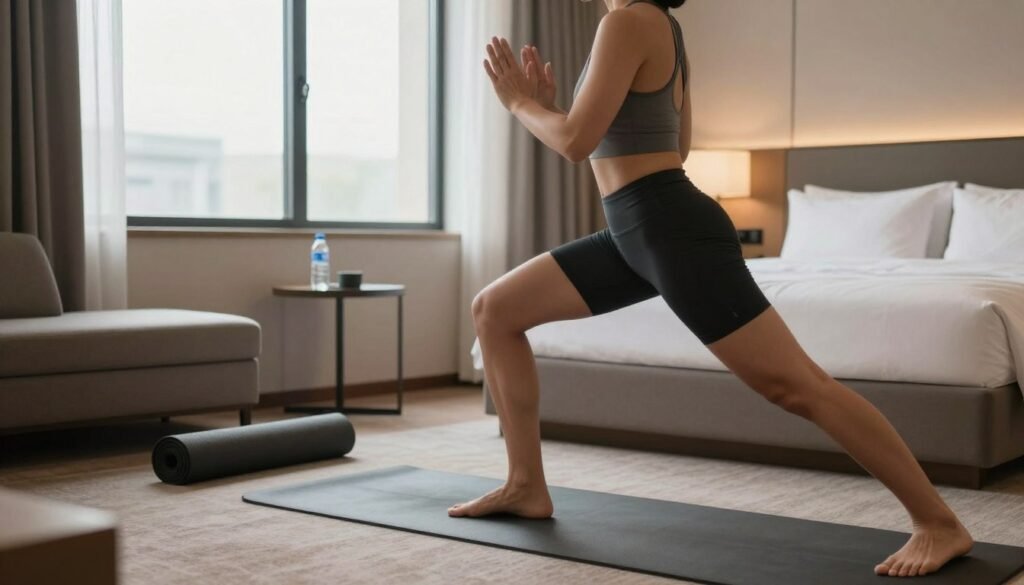
- Squats: 40 seconds of controlled movement, 20 seconds rest
- Push-ups: 40 seconds (modify on knees if needed), 20 seconds rest
- Alternating lunges: 40 seconds, 20 seconds rest
- Plank hold: 40 seconds, 20 seconds rest
- Mountain climbers: 40 seconds, 20 seconds rest
I repeat this circuit 3 to 4 times, depending on my energy. The 40-second intervals feel manageable, even when tired from travel.
The secret is intensity over volume. I push myself hard during each interval. A few challenging sets do more than long, easy workouts.
Cool-Down Stretches
After the circuit, I spend 5 minutes on static stretches. This reduces soreness and improves flexibility.
I hold each stretch for 20 to 30 seconds without bouncing:
- Standing hamstring stretch (reach toward toes)
- Quad stretch (pull foot toward glutes)
- Hip flexor lunge stretch
- Chest opener (clasp hands behind back)
- Shoulder stretches (pull arm across body)
- Neck rolls and shoulder shrugs
This cool-down leaves me feeling accomplished and ready for the day. It’s the perfect way to start any morning on the road.
Quick Evening Wind-Down Routine
When I return to my hotel after a long day, I don’t want an intense workout. This gentler routine keeps me active without overstimulating my system before bed.
Low-Impact Movements
These exercises keep me active without raising my heart rate too much. I perform each movement slowly and with control.
- Bodyweight squats: 3 sets of 15 reps
- Wall push-ups: 3 sets of 12 reps
- Slow alternating lunges: 2 sets of 10 per leg
- Standing calf raises: 2 sets of 20 reps
The focus is on quality movement patterns, not exhaustion. I’m maintaining my strength without affecting my sleep.
Relaxation Exercises
After the low-impact movements, I do restorative stretches and breathing exercises. This signals my body to wind down.
My favorite evening sequence includes:
- Child’s pose: Hold for 1 to 2 minutes while breathing deeply
- Cat-cow stretches: 10 slow repetitions
- Seated forward fold: Hold for 1 minute
- Supine spinal twist: 30 seconds each side
- Box breathing: 4 counts in, 4 counts hold, 4 counts out, 4 counts hold (5 minutes)
This routine helps me sleep better in unfamiliar hotel beds. The gentle movement and breathing calm my nervous system.
High-Intensity Interval Training for Small Spaces
When I’m short on time but want maximum results, I do HIIT workouts. These travel workout routines deliver serious fitness benefits in minimal time and space.
15-Minute HIIT Workout
This Tabata-style workout gets my heart pumping and burns calories long after. The format is simple but challenging.
I perform each exercise for 30 seconds at maximum effort, followed by 15 seconds of rest. Then I move to the next exercise.
- High knees: 30 seconds work, 15 seconds rest
- Squat jumps: 30 seconds work, 15 seconds rest
- Burpees (or modified step-back burpees): 30 seconds work, 15 seconds rest
- Mountain climbers: 30 seconds work, 15 seconds rest
I complete this sequence 5 times through. That gives me exactly 15 minutes of work, including rest periods. The workout feels short but incredibly effective.
The key principle is density training—doing more work in less time. This approach is perfect for maintaining fitness during travel when you can’t access your regular gym.
Quiet Exercises for Shared Walls
I’ve learned that hotel neighbors don’t like jumping exercises at 6 AM. When I need to keep the noise down, I swap in quieter alternatives.
Here are my go-to substitutions:
- Replace jump lunges with step-back lunges
- Swap high knees for fast feet (rapid stepping in place)
- Use plank variations instead of burpees
- Do quick squats instead of squat jumps
- Perform standing oblique crunches instead of jumping jacks
These modifications maintain the intensity while dramatically reducing impact noise. I can get a great workout without disturbing anyone.
All of these hotel room fitness routines have been tested and refined through my extensive travel experience. They work because they’re practical, efficient, and require no special equipment.
For more workout variations and detailed video demonstrations, visit www.healthyvibeslife.com. There, you’ll find routines for different fitness levels and time constraints. You can also subscribe to the newsletter for weekly workout ideas, wellness travel tips, and the latest fitness product recommendations delivered straight to your inbox.
The best workout is the one you’ll actually do. Having these proven routines in your back pocket removes all excuses and keeps you consistent no matter where your travels take you.
✈️ Exercising While Traveling: Airports, Planes, and Road Trips
Traveling between places offers more chances to stay fit than many think. You don’t need a gym or special gear to stay active. Just be aware and move whenever you can. These small actions add up and make a big difference in how you feel when you arrive.
The idea of NEAT, or Non-Exercise Activity Thermogenesis, has changed how I view travel days. Every step, stair climb, and stretch helps your health and energy. Exercising during transit keeps blood flowing, prevents stiffness, and keeps energy levels stable during long trips.
Airport Terminal Workouts
Airports have become my unexpected fitness spots. I arrive 20 minutes early to move before my flight. This extra time turns waiting into valuable activity, setting a positive tone for the trip.
Walking Routes and Stair Climbing
Walking in the terminal is my favorite airport activity. Many airports have long terminals, perfect for walking. I try to walk the full length of my terminal at least once before boarding.
When I see stairs, I choose them over escalators and elevators. This adds dozens of flights to my daily step count. Airports like Philadelphia International and Denver International have long stairways for great cardio.
In less busy times, I do walking lunges down empty concourses. It might look odd, but the workout benefits are worth it. Walking and stair climbing can burn 150-200 calories per hour while waiting for your flight.
Finding a quiet spot near your gate opens up stretching options. I’ve developed a discreet routine that loosens tight muscles from sitting during the drive to the airport.
My go-to stretches include standing quad stretches and calf stretches. I also do hip flexor lunges to counteract hip tightness from car seats. Upper back stretches help after carrying luggage.
Neck rolls in both directions are essential after carrying luggage. These stretches take only five minutes but make hours of sitting more comfortable.
In-Flight and In-Car Exercises
Long sitting during flights and road trips is the biggest challenge. I’ve found that small movements throughout the journey prevent stiffness and discomfort. These exercises are discreet, so other passengers rarely notice.
Seated Leg Lifts and Ankle Rotations
Lower body circulation drops during extended sitting. I combat this by doing seated leg exercises every 30-45 minutes. Ankle circles in both directions help get blood flowing again.
Pointing and flexing my feet engages the calf muscles, acting as a natural pump for blood return. I also raise my heels while keeping my toes on the floor, then reverse by lifting my toes while heels stay down. Each movement gets 15-20 repetitions.
Knee lifts are another favorite exercise. I subtly raise one knee a few inches off the seat, hold for three seconds, then lower it. Alternating legs for ten repetitions each side activates the hip flexors and core. Glute squeezes performed for 10-second holds help maintain muscle activation even while seated.
Upper Body Stretches
Upper body tension builds up quickly during travel, affecting the neck and shoulders. My in-flight stretching routine starts with gentle neck tilts, bringing my ear toward each shoulder and holding for 15 seconds per side. Slow neck rolls in full circles help release accumulated tension.
Shoulder shrugs and rolls are remarkably effective for upper back relief. I lift both shoulders toward my ears, hold for three seconds, then release. Rolling shoulders backward in large circles ten times helps counteract the forward slouch that develops during travel.
Seated spinal twists work well in airplane and car seats. I place my right hand on the outside of my left thigh and gently rotate my torso to the left, looking over my left shoulder. Holding this position for 20 seconds on each side releases lower back tension. Overhead reaches with interlaced fingers stretch the entire spine and shoulders beautifully.
Breathing and Posture Techniques
Proper breathing changes how your body handles long sitting periods. I practice diaphragmatic breathing by placing one hand on my chest and one on my belly, ensuring the belly hand moves more than the chest hand. This keeps me oxygenated and relaxed throughout the journey.
Maintaining good spinal alignment requires conscious effort during travel. I periodically check that my lower back maintains its natural curve against the seat back. Adjusting my sitting position every 20-30 minutes prevents any single posture from becoming problematic.
The “seated mountain pose” from yoga helps reset my posture. I sit tall with feet flat on the floor, spine elongated, shoulders back and down, and crown of the head reaching upward. Holding this alignment for 30-second intervals throughout the flight keeps postural muscles engaged.
Rest Stop Fitness During Road Trips
Road trip fitness depends on how you use your rest stops. I plan to stop every 90-120 minutes during long drives, using each break as a mini-workout opportunity. These regular movement sessions prevent the deep fatigue that comes from hours of continuous driving.
Quick 5-Minute Movement Breaks
My standard rest stop routine takes exactly five minutes and hits every major muscle group. I start with 30 seconds of arm circles, swinging both arms forward and backward in large circles to wake up my shoulders after gripping the steering wheel.
Bodyweight squats come next—one full minute of continuous squats at a moderate pace usually gives me 20-25 repetitions. Walking lunges around the parking lot for one minute get my legs fully engaged. I aim for 20-30 total lunges, alternating legs with each step.
Standing quad and hamstring stretches take another minute, holding each position for 15 seconds. Upper body stretches including overhead reaches, side bends, and torso twists fill the fourth minute. I finish with 30 seconds of deep breathing, taking five slow, deliberate breaths that fully expand my lungs.
Full-Body Stretching Routine
When I have more time or feel stiff, I extend my rest stop to include a 10-minute stretching sequence. This routine targets every major muscle group with 30-second static holds that promote genuine flexibility improvements over the course of a multi-day road trip.
The sequence begins with neck stretches in all four directions, followed by shoulder and upper back stretches. I then move through standing quad stretches, hamstring stretches with one foot elevated on a car bumper, and hip flexor lunges. Calf stretches against the car and gentle spinal twists complete the lower body work.
This approach to road trip fitness makes multi-hour drives significantly more comfortable and reduces the stiffness that typically follows long travel days. The investment of 10 minutes every two hours pays dividends in energy and comfort.
| Travel Scenario | Recommended Exercises | Frequency | Duration | Primary Benefits |
|---|---|---|---|---|
| Airport Terminal | Walking routes, stair climbing, gate area stretches | Upon arrival until boarding | 15-30 minutes | Cardiovascular activity, calorie burn, reduced pre-flight stiffness |
| In-Flight/In-Car | Ankle rotations, seated leg lifts, upper body stretches, breathing exercises | Every 30-45 minutes | 3-5 minutes per session | Improved circulation, reduced DVT risk, decreased muscle tension |
| Rest Stops | Bodyweight squats, lunges, full-body stretches | Every 90-120 minutes | 5-10 minutes | Mental alertness, muscle activation, flexibility maintenance |
| Layover Periods | Terminal walking, stairwell circuits, stretching sequences | During connection time | 20-45 minutes | Energy restoration, movement compensation, stress reduction |
These activities during transit aren’t a substitute for workouts, but they’re great supplements. They help keep your fitness level up. Consistent movement during travel days prevents physical regression from extended trips.
Staying active during transit reduces stiffness by up to 60%, maintains circulation, boosts mental energy, and significantly improves how you feel upon arrival. When I incorporate these practices, I arrive at my destination feeling energized, not drained. Jet lag symptoms decrease, and I’m ready to explore or work sooner than when I’m sedentary.
The key insight about exercising while traveling during transit is that fitness isn’t just for gyms or workouts. Movement opportunities exist throughout every travel day if you’re willing to recognize and act on them. This approach shows that staying fit on the road goes beyond hotel room workouts to include your entire journey from start to finish.
🎒 Best Portable Exercise Equipment I Always Pack
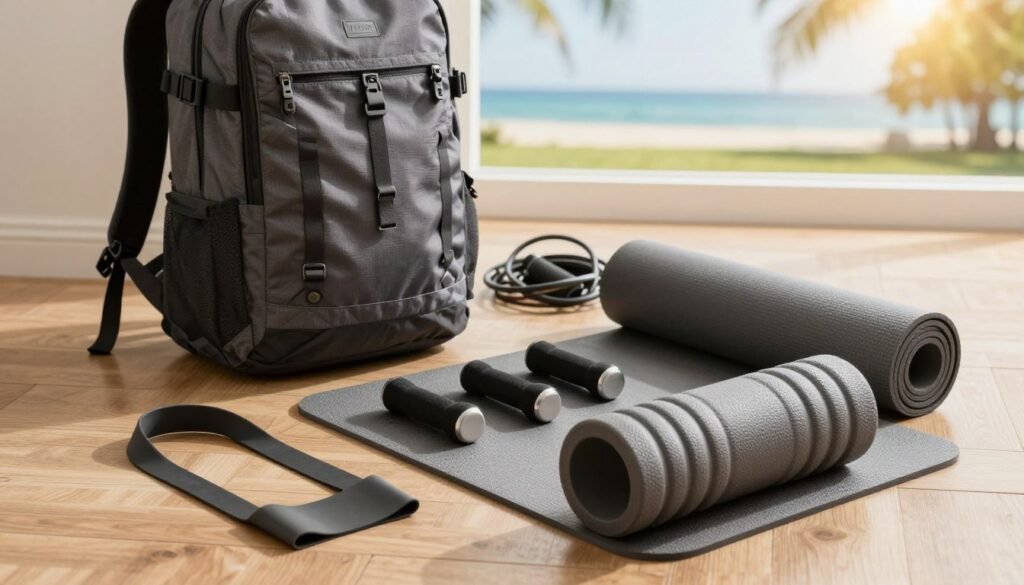
Bodyweight exercises are key for my workouts on the go. But, adding portable gear has really boosted my fitness. Push-ups and squats are great, but having a few tools opens up new possibilities.
I’ve tested many travel fitness items to find the best. The gear I share here has proven itself in many places.
These tools add resistance, variety, and keep workouts intense. Plus, they’re light and pack flat.
Resistance Bands for Strength Training
If I had to choose one thing, it’s resistance bands. They’ve changed my workouts more than anything else.
Bands let you do many gym exercises with little space. You can do rows, presses, squats, and more anywhere.
They’re easy on your joints, pack small, and adjust easily. One or two bands can work your whole body.
Types and Resistance Levels
Knowing about band types helps you choose the right one. Loop bands are circles without handles, good for legs and activation.
Bands with handles have grips and door anchors for upper body work. I carry one of each for more options.
Most bands use colors to show resistance levels. They range from 5 pounds (light) to 50+ pounds (heavy).
It’s smart to have at least two bands. Use a lighter one for warm-ups and reps, and a heavier one for strength.
My Favorite Band Exercises
Here are the band exercises I do most:
- Banded rows: Anchor the band to a door or furniture and pull toward your chest for back work
- Banded chest presses: Wrap the band behind your back and press forward for chest and tricep work
- Banded squats: Stand on the band and hold the handles at shoulder height to add resistance to your squats
- Banded deadlifts: Step on the band center and hinge at the hips while holding the handles
- Banded lateral walks: Place a loop band around your thighs and step sideways for glute activation
- Banded shoulder presses: Stand on the band and press the handles overhead
- Banded pull-aparts: Hold the band at chest height and pull it apart to strengthen your upper back
Bands offer constant tension, unlike free weights. This makes them great for muscle activation.
Compact Jump Rope for Cardio
For cardio on the go, my jump rope is unbeatable. It gives intense cardio and improves coordination and heart health.
A good jump rope costs under $15 and weighs almost nothing. It’s a better workout than a 30-minute treadmill session.
Benefits and Technique Tips
Jumping rope is great for travelers. It burns calories fast—about 10-15 per minute.
It also improves footwork and strengthens your calves, core, and shoulders. Plus, it’s calming, reducing travel stress.
Here’s how to jump rope right:
- Check rope length: Stand on the center of the rope; the handles should reach your armpits
- Jump position: Stay on the balls of your feet with a slight knee bend
- Wrist rotation: Use wrist rotation instead of big arm movements
- Start gradually: Begin with 30-second intervals if you’re new to jumping rope
I jump for 30 seconds, then rest for 30 seconds. Do this for 10-15 rounds for a great cardio workout in 10 minutes.
Space Considerations
Jump rope needs about 6 feet of space in each direction and enough ceiling height.
This makes outdoor spots or hotel conference rooms better than small rooms. I often jump in hotel parking lots, parks, or outdoor patios.
Always check for low-hanging things or obstacles before jumping. Safety is key when using gear in new places.
Travel Yoga Mat and Alternatives
A clean surface is key for floor exercises. I’ve tried many mats to find ones that are portable and work well.
Foldable Mat Options
Traditional yoga mats are too big for luggage. Ultra-thin travel mats are a better choice.
These mats are 1-2mm thick and fold flat. They fit in your suitcase with your clothes.
They’re not as cushioned as studio mats but work for most exercises and yoga poses.
My favorite mat folds into a small square, like a book. It’s light and takes up little space.
Using Hotel Towels
When I forget my mat, hotel towels are a good substitute. A big towel is enough for floor exercises and yoga.
Towels are great for planks, mountain climbers, and core exercises. They’re also good for towel rows, a back exercise.
The downside is towels can bunch or slide. Use a towel on carpet for better grip.
TRX Suspension Trainer System
The TRX is the most versatile gear in my collection. It uses straps to create many exercises.
It’s a bit bigger than bands but offers unique challenges. It’s worth it for the variety it adds.
Setup in Hotel Rooms
Setting up your TRX in hotel rooms is easy. The door anchor lets you secure it over any door.
Just place the anchor on the door, close it, and test it. Always pull toward the hinge side for safety.
You can also use it on beams, railings, or pull-up bars. I’ve set it up in many places.
Essential TRX Exercises
Here are some key TRX exercises:
- Suspended push-ups: Feet in the straps make push-ups more challenging
- TRX rows: Lean back and pull your chest toward your hands for back work
- TRX squats: Hold the handles for balance while doing deep squats
- Suspended lunges: Place one foot in the strap behind you for Bulgarian split squats
- TRX plank variations: Feet in straps make basic planks more intense
- TRX pike: From plank position, pull your hips toward the ceiling
TRX exercises challenge stabilizer muscles, improving functional strength.
Other Lightweight Fitness Tools
There are smaller items that enhance my workouts. These tools help with recovery and fill specific training gaps.
Massage Balls and Foam Rollers
Travel can be tough on your muscles. Long flights and uncomfortable seats cause tension and soreness.
Travel-sized foam rollers or collapsible ones relieve muscle tension without taking up much space. Some models are hollow, letting you pack clothes inside.
I prefer lacrosse balls or massage balls for trigger points. A single ball weighs a few ounces but can release tension in your back, glutes, and feet.
Using these tools for 5-10 minutes before bed improves sleep quality. They’re essential after long flights or busy days.
Hand Grippers and Sliders
Hand grippers are small tools that strengthen your forearms. I use mine during calls or at airports.
Furniture sliders might seem odd, but they’re great for exercises. Place them under your hands or feet on smooth floors.
Sliders make mountain climbers, body saws, hamstring curls, and lunges easier. A pair costs a few dollars and adds variety to your workouts.
| Equipment Type | Weight | Primary Benefits | Best For | Price Range |
|---|---|---|---|---|
| Resistance Bands | 4-8 oz | Full-body strength training with adjustable resistance | All fitness levels | $10-$30 |
| Jump Rope | 3-6 oz | High-intensity cardio and coordination | Cardio enthusiasts | $8-$25 |
| Travel Yoga Mat | 12-16 oz | Clean surface for floor exercises | Yoga and core work | $20-$40 |
| TRX System | 1.5-2 lbs | Hundreds of suspension exercises | Advanced training | $130-$200 |
| Massage Ball | 2-4 oz | Trigger point release and recovery | Recovery focused | $5-$15 |
I’ve reviewed these products on my website at www.healthyvibeslife.com. You’ll find brand recommendations, tutorials, and honest reviews based on real use.
Subscribe to my newsletter for updates on fitness products. You’ll get discounts, exclusive deals, and detailed reviews to help you choose the right gear for your travel workouts.
The right portable equipment makes your travel workouts better. Start with resistance bands and add more as you find what works for you.
📅 How to Stay Fit on the Road: Maintaining Your Exercise Routine Away From Home
Keeping up with exercise while traveling takes planning and smart choices. It’s not about willpower or motivation. It’s about having systems that make it easy to stay consistent.
Before you leave, plan your workouts like you would book a flight. This approach makes a big difference.
Planning and Scheduling Strategies
Structure is key when it comes to staying fit while traveling. Without a plan, workouts become optional. And when you’re in a new place, it’s easy to let them slip.
I create a workout plan that travels with me. I switch between two routines to keep things interesting and prevent boredom.
Treating Workouts as Non-Negotiable Appointments
This strategy has been the most impactful for me. I schedule my workouts in my calendar app, just like I would any other important meeting.
Each workout gets a specific time block with a reminder set 15 minutes before. I don’t say “maybe workout” or “try to exercise.” Instead, I write exactly what I’ll do, like “30-minute hotel room HIIT” or “Morning resistance band routine.”
If someone wants to schedule something during my workout time, I treat it like any other commitment. I either suggest an alternative time or reschedule my workout if it’s urgent.
Deciding when I’ll work out before my trip eliminates daily mental battles. Early morning workouts before breakfast work best for me because the day hasn’t gotten complicated yet.
Time Zone Adjustments
Traveling across time zones used to mess up my fitness routine. Now, I use exercise to adjust to new time zones faster.
When traveling east, I schedule morning workouts to wake up in the new time zone. When traveling west, evening workouts help me stay awake until bedtime.
For the first day or two after arrival, I might keep my workout at my “home time” if it’s more practical. The key is being flexible with timing but not skipping workouts.
Adapting Your Regular Fitness Program
Many travelers think they need to abandon their regular workout when they travel. But the better approach is to adapt smartly.
I see travel periods as maintenance phases, not progress phases. This mindset removes pressure and sets realistic goals.
Modifying Gym Workouts for Travel
Changing my gym routine for travel was challenging at first. But I’ve found reliable substitutes that work well. The key is matching movement patterns, not exact exercises.
| Gym Exercise | Travel Alternative | Equipment Needed |
|---|---|---|
| Barbell Squats | Single-leg split squats or jump squats | None or resistance band |
| Bench Press | Push-ups or band chest press | None or resistance band |
| Barbell Rows | Band rows or towel rows using door | Resistance band or towel |
| Lat Pulldowns | Band pull-downs or door frame hangs | Resistance band or sturdy door frame |
| Leg Press | Bulgarian split squats | Chair or bed edge |
I focus on keeping the same basic movement patterns, even when the specific exercises change. This keeps my body working in familiar ways, despite the different environment.
Reducing Volume While Maintaining Intensity
This principle has been a game-changer for my travel fitness: you can significantly reduce training volume while maintaining intensity. This preserves your strength and muscle for weeks.
Research shows cutting volume by 50% or more during maintenance phases is okay, as long as you keep the effort level high. Instead of doing 4 sets of 10 exercises, I might do 2 sets of 5 exercises but push those sets harder.
What does this look like practically? At home, I might do 16 total sets of upper body work across multiple exercises. While traveling, I’ll do 8 total sets but make each one really count by increasing difficulty or slowing tempo.
This approach prevents burnout and overtraining while keeping my fitness level steady. When I return home, I can ramp volume back up without having lost ground.
Technology and Apps I Use
Technology has become my secret weapon for staying fit on the road. The right apps and tools provide structure, guidance, and accountability when I’m far from my regular gym and routine.
I’m not talking about complicated systems or expensive subscriptions. Most of the tools I rely on are either free or very affordable.
Workout Apps and YouTube Channels
I keep several workout apps downloaded on my phone for different situations and preferences. Nike Training Club offers excellent bodyweight workouts ranging from 15 to 45 minutes with clear video demonstrations.
FitOn provides free guided workouts including HIIT, strength, yoga, and stretching sessions perfect for hotel rooms. I like their filters that let me search by duration and equipment availability.
For YouTube, I’ve built a playlist of reliable channels that specialize in travel and hotel room workouts. Having these saved means I don’t waste time searching when I’m ready to exercise.
- Fitness Blender for no-equipment workouts of various lengths
- Heather Robertson for follow-along HIIT and strength training
- Body Project for low-impact options when I need something gentler
- Yoga With Adriene for stretching and mobility work
I also use simple interval timer apps for creating custom HIIT workouts. These let me design my own work-to-rest ratios without needing to watch a video.
Fitness Trackers for Accountability
My fitness tracker has become non-negotiable for travel. It provides objective data that keeps me honest about my actual activity level versus what I think I’m doing.
I set a daily step goal of 8,000-10,000 steps, which sounds high but is surprisingly achievable even on travel days if I’m intentional about it. Walking through airports, taking stairs, and exploring new cities all contribute.
The workout completion tracking feature creates a visual streak that I’m motivated to maintain. Seeing that chain of completed workout days makes me less likely to skip, even when I’m tired from travel.
Sleep tracking has also been valuable because travel often disrupts sleep quality. When I notice my sleep score dropping, I adjust my evening routine and sometimes reduce workout intensity to prioritize recovery.
Finding Local Gyms and Fitness Classes
Sometimes I want access to real gym equipment or crave the energy of a group fitness class. Over the years, I’ve developed efficient strategies for finding these options wherever I travel.
This approach works well for longer trips where I’m staying in one location for several days or more. The effort of finding a facility pays off when I can use it multiple times.
Day Pass Options
Most commercial gyms and fitness studios offer day passes or week passes for travelers. I’ve learned to research these options before my trip, not after.
A quick Google search for “gyms near [my hotel address]” usually reveals several options within walking distance or a short Uber ride. I check their websites or call ahead to confirm day pass availability and pricing.
ClassPass has been incredibly useful for accessing various fitness studios in different cities with a single membership. I can drop into yoga studios, cycling classes, martial arts gyms, or CrossFit boxes depending on what’s available and what I’m in the mood for.
Hotel concierges are also valuable resources. I always ask if they have partnerships with nearby gyms that offer discounted or free access to hotel guests. You’d be surprised how often this option exists but isn’t advertised.
Outdoor Exercise Locations
Some of my best travel workouts have happened outdoors in beautiful locations I’d never have visited. I’ve done bodyweight circuits in city parks, run along waterfront paths, and hiked scenic trails all while technically “working out.”
Before trips, I research local parks, running trails, and outdoor fitness equipment using resources like AllTrails for hiking options and local city websites for park amenities. Many cities now have outdoor fitness equipment in public parks that’s completely free to use.
I look for locations that offer both beauty and functionality—botanical gardens with walking paths, beachfront areas with stairs or boardwalks, or parks with hills for sprint intervals. These spots make exercise feel less like a chore and more like exploration.
Safety is important, so I check reviews and local recommendations. I exercise during daylight hours in unfamiliar areas and let someone know where I’m going if I’m heading out alone in a new city.
The key to maintaining exercise routine away from home is making fitness a priority in your travel planning, not an afterthought that you hope to squeeze in if time allows.
These business trip health tips have helped me stay consistent across hundreds of travel days. The planning might seem like extra work initially, but it quickly becomes automatic and saves enormous mental energy once you’re actually traveling.
For more detailed guides on adapting specific workout programs for travel, visit www.healthyvibeslife.com. Subscribe to the newsletter where you’ll receive weekly planning templates, printable travel workout logs, and strategies for maintaining your routine no matter where your travels take you.
🥗 Healthy Eating on Vacation: Nutrition Tips for Business Trip Health
Healthy eating on vacation is not about cutting out food. It’s about making smart choices that boost your energy and fitness. After years of traveling, I’ve learned that good nutrition is key to feeling great on trips. Eating well and exercising regularly is the best way to stay healthy while traveling.
Traveling often means you have less control over your food. You’ll face airport food, restaurant menus, and limited grocery stores. But with the right strategies, you can stay healthy without feeling deprived.
Smart Restaurant Ordering Strategies
Eating out doesn’t have to ruin your diet. I’ve learned how to order wisely at restaurants. Knowing what to look for and using a few key strategies can help you make healthy choices.
Look for words like “grilled,” “baked,” “steamed,” or “roasted” on menus. These indicate healthier cooking methods. Such dishes are often more nutritious and flavorful than fried foods.
Be cautious of words like “fried,” “breaded,” “creamy,” “crispy,” or “smothered.” They often mean dishes with extra fats and calories. These can make you feel sluggish.
Always ask for dressings and sauces on the side. This lets you control how much you use. Restaurant portions of dressing are usually too much, and using it separately helps you enjoy flavors without overdoing it.
Choose dishes with vegetables as main ingredients. These are often more balanced and satisfying. Opt for lean proteins like chicken, fish, turkey, or plant-based options like beans and lentils.
Portion Control Techniques
Restaurant portions in the U.S. are often too big. I’ve learned to control my portions to avoid overeating. My favorite trick is to ask for a to-go box right away and portion half the meal before eating.
This method helps prevent mindless eating and saves money. It also gives you another meal for later. Sharing large entrees with friends is another good strategy, as most main courses are enough for two.
Ordering appetizer portions as your main course is also effective. Many restaurants offer smaller versions of popular dishes. You don’t have to stick to the entree section.
Balancing Indulgence and Nutrition
I follow an 80/20 approach to nutrition while traveling. I make healthy choices for 80% of my meals and allow for indulgences for 20%. This balance keeps me from feeling restricted while supporting my health goals.
It’s important to avoid the mindset that “nothing matters” on vacation. While one indulgent meal won’t hurt, several days of poor eating can impact your health. I’ve experienced this firsthand—after three days of eating poorly, I felt bloated and low-energy.
I try to be mindful of my indulgences. If I want to try a local specialty, I do so without guilt. But I don’t use travel as an excuse to eat poorly at every meal, even if it’s just chain restaurant food.
Staying Hydrated During Travel
Hydration is key for maintaining energy and health while traveling. Dehydration can cause fatigue, headaches, and decreased performance. I make hydration a top priority during all my trips.
Water Intake Goals
I aim to drink 64-80 ounces of water daily when traveling. This amount increases in hot climates or on active days. Drinking water throughout the day is manageable, and I start with a full glass in the morning.
Carrying a reusable water bottle is essential. I fill it after security, keep it with me, and refill it often. This makes drinking water automatic.
Phone reminders help me stay hydrated, even when I’m busy. These reminders ensure I drink water consistently, regardless of my schedule.
Avoiding Dehydration on Flights
Airplane cabin air is very dry, with humidity levels around 10-20%. It’s important to drink water before, during, and after flights. I aim to drink about 8 ounces of water for every hour of flight time.
I avoid alcohol before and during flights because it dehydrates you further. While I enjoy wine, it makes me feel worse on planes, leading to fatigue and discomfort.
After landing, I prioritize rehydration. Drinking extra water helps my body recover from the flight and adjust to the new time zone. This simple practice improves how quickly I overcome travel fatigue.
Limiting Alcohol and Caffeine
Both alcohol and caffeine are diuretics, increasing fluid loss. I’m mindful of my consumption and balance them with extra water. For every cup of coffee or drink, I try to drink an additional glass of water.
These beverages can disrupt sleep, which is critical when dealing with jet lag or busy travel schedules. Limiting caffeine after 2 PM and avoiding alcohol close to bedtime helps me sleep better in unfamiliar places.
Moderation is key. Enjoying a morning coffee or an evening drink with colleagues is fine. But excessive consumption can significantly affect how you feel and perform during your trip.
Healthy Snacks I Always Pack
Bringing my own snacks is a key strategy for healthy eating on vacation. It ensures I have nutritious options available, regardless of what food choices I encounter. Having these snacks prevents me from making poor decisions when I’m extremely hungry and faced with limited options.
Protein-Rich Options
Protein keeps me satisfied between meals and supports muscle recovery after workouts. I pack several protein-rich snacks that travel well and don’t require refrigeration:
- Individual nut butter packets – These are perfect for eating with fruit or whole grain crackers
- Protein bars – I choose ones with minimal ingredients and less than 10 grams of sugar
- Beef jerky or turkey jerky – High in protein and extremely portable
- Roasted chickpeas or edamame – Great plant-based protein sources
- Protein powder in individual packets – I can mix these with water when I need a quick protein boost
These options have saved me countless times when meetings run late, flights are delayed, or I find myself in areas with limited healthy food options.
Fruits and Vegetables
Fresh produce provides essential vitamins, minerals, and fiber that can be hard to get when eating out frequently. I pack fruits and vegetables that travel well and don’t require immediate refrigeration:
- Apples, oranges, and bananas – These sturdy fruits withstand being tossed in a bag and last several days
- Baby carrots and cherry tomatoes – Perfect for shorter trips or when I have access to a small cooler
- Dried fruits like apricots or mango – I watch my portions as they are sugar-dense, but they’re great for satisfying sweet cravings
Having these healthy options readily available makes it much easier to get adequate produce servings even when restaurant meals are vegetable-light.
TSA-Friendly Choices
For air travel, I’m careful to pack only TSA-approved snacks. Solid foods are allowed through security, but liquids must be 3.4 ounces or less and fit in a quart-sized bag. This means yogurt, hummus, and nut butters in larger containers need to stay home or be purchased after security.
My go-to TSA-friendly snacks include nuts, seeds, dried fruit, granola bars, protein bars, crackers, and whole pieces of fruit. I pack these in a separate, easily accessible bag so I can grab them quickly during my journey.
For road trips, I have more flexibility and often bring a small cooler with additional options like Greek yogurt, string cheese, cut vegetables with hummus, and sandwiches for longer drives.
Navigating Hotel Breakfasts and Buffets
Hotel breakfasts present unique challenges and opportunities. The convenience of having breakfast included is wonderful, but buffets can lead to overeating. I’ve developed strategies to build balanced plates without falling into common traps.
Building Balanced Plates
I approach hotel breakfast buffets with a plan. I survey all options before putting anything on my plate. This prevents me from loading up on the first items I see and running out of room for healthier choices I discover later.
My breakfast plate always includes these three components:
- Protein – Eggs (scrambled, hard-boiled, or omelet), Greek yogurt, cottage cheese, turkey sausage, or smoked salmon
- Fiber and complex carbohydrates – Oatmeal, whole grain toast, fresh fruit, or high-fiber cereal
- Vegetables – Fresh fruit, tomatoes, peppers for omelets, spinach, or any available vegetable options
This combination provides sustained energy for my morning activities without the blood sugar crash that comes from loading up on pastries and sugary cereals. I keep my portions reasonable despite the all-you-can-eat format, eating until I’m satisfied, not uncomfortably full.
Avoiding Common Pitfalls
The biggest mistake I see travelers make at hotel breakfasts is loading plates with muffins, pastries, waffles, and sugary cereals. While I occasionally enjoy these treats, making them the foundation of my breakfast leaves me feeling sluggish and hungry again within a couple hours.
Another trap is going back for multiple plates out of boredom or because you’re not paying per item. I remind myself that just because food is included doesn’t mean I need to maximize consumption. The goal is to fuel my body appropriately, not to “get my money’s worth” by overeating.
Skipping breakfast entirely is also problematic. When I’ve skipped breakfast to save time or because nothing looked appealing, I’ve consistently made poor food choices later in the day when I became extremely hungry. A moderate, balanced breakfast sets a positive tone for the entire day.
These nutrition strategies have become fundamental to my business trip health routine. Combined with regular exercise, they help me maintain energy levels, support my workouts, and feel good throughout extended travel periods. For more detailed nutrition guides, healthy travel recipes, and meal planning templates, visit www.healthyvibeslife.com. Subscribe to the newsletter for weekly nutrition tips, healthy restaurant recommendations, and exclusive wellness travel deals.
⏰ Time Management for Road Trip Fitness and Business Trips
Finding time for road trip fitness is tough, not because of motivation, but because of a packed schedule. Early flights, meetings, dinners, and sightseeing make it hard to fit in hour-long workouts. The key is to use the time you have wisely.
Travel days are unpredictable. Flights get delayed, meetings run long, and networking chances pop up. To stay fit, adapt your fitness routine to fit these changes. Focus on shorter workouts, mix movement into daily activities, and be flexible with your schedule.
Maximizing Limited Time with Micro-Workouts
Micro-workouts have changed how I stay active while traveling. These short sessions, lasting 5-10 minutes, add up to significant fitness benefits. Instead of thinking you can’t work out in 45 minutes, see what you can do in 7 minutes.
Research supports “movement snacks” as a way to fight sitting and boost mental clarity. These short bursts of activity can make a big difference between meetings.
Movement snacks—short bursts of activity lasting only a few minutes—reduce inactivity and boost mental well-being.
Doing three 5-minute sessions a day adds up to 15 minutes of exercise. This is better than nothing and often more doable than finding a full hour for a workout during business travel.
5-Minute Exercise Breaks
I follow a simple routine for my 5-minute exercise breaks every 2-3 hours. This no-equipment circuit fits into any schedule:
- Minute 1: Bodyweight squats (aim for 20-30 reps)
- Minute 2: Push-ups or wall push-ups (10-20 reps)
- Minute 3: Alternating lunges (15-20 per leg)
- Minute 4: Plank hold (maintain proper form)
- Minute 5: Jumping jacks or marching in place
Use a phone timer for these breaks. Schedule them around natural day transitions—after breakfast, between meetings, and before dinner. The effect on your energy and fitness is impressive.
Desk Exercises for Business Travelers
When meetings fill your schedule, desk exercises are a lifesaver. You can do these in your business clothes without sweating. They’re perfect for conference rooms or hotel workspaces:
- Seated leg raises: Extend one leg straight and hold for 30 seconds, alternating sides
- Desk push-ups: Place hands on desk edge and perform 10-15 controlled push-ups
- Calf raises: Stand during phone calls and perform 20-30 raises
- Seated torso rotations: Twist side to side to engage core muscles
- Shoulder blade squeezes: Pull shoulders back and hold for 5 seconds, repeat 10 times
These aren’t full workouts, but they’re great supplements. On days when nothing else is possible, they keep your body active and counteract sitting’s negative effects.
Combining Sightseeing with Physical Activity
Merging sightseeing with exercise is one of my favorite strategies. It lets you explore while staying active. I’ve logged over 20,000 steps on sightseeing days without even thinking of it as exercise.
The key is to make active choices. Instead of choosing convenience, ask yourself, “How can I make this more active?” This simple question turns passive tourism into fitness opportunities.
Walking Tours and Hiking
Walking tours offer cultural immersion and exercise. I prefer walking tours over bus tours when exploring new cities. The slower pace lets you notice details while increasing your step count.
Research hiking trails near your destination before you travel. Apps like AllTrails show options at every difficulty level. Even a moderate 2-hour hike burns 400-600 calories and offers unique experiences you won’t get from a hotel gym.
I also walk to restaurants and attractions whenever possible. That 15-minute walk to dinner becomes 30 minutes of exercise round-trip. Use your phone’s step tracker to monitor this incidental activity—you’ll be surprised how quickly it adds up.
Biking Rentals and Water Sports
Many cities now offer bike-share programs, making exploring on two wheels easy. I’ve discovered neighborhoods in Portland, Austin, and Boston that I would have missed in a car or taxi. Biking provides a great cardiovascular workout while covering more ground than walking.
Coastal destinations offer fantastic fitness opportunities through water sports. Kayaking, paddleboarding, and snorkeling deliver full-body workouts disguised as recreation. I prioritize these activities because they create memorable experiences while supporting business trip health goals.
The mental break from work-related activities also reduces stress. You return to meetings refreshed and energized, not drained from another gym session.
Optimal Workout Timing on the Road
Timing is key for whether your workout happens during travel. Through years of experimentation, I’ve found the best timing strategies. Understanding these patterns helps you schedule exercise when it’s most likely to occur.
| Workout Timing | Success Rate | Primary Benefits | Main Challenges |
|---|---|---|---|
| Early Morning (5-7 AM) | 85-90% | Least likely to be disrupted; beats jet lag; hotel gym access | Requires early wake-up; may feel groggy initially |
| Lunch Break (11 AM-1 PM) | 60-70% | Breaks up workday; boosts afternoon energy; convenient | Time constraints; may need to eat quickly after |
| Evening (5-8 PM) | 40-50% | Natural end to workday; can be social activity | Most vulnerable to cancellation; may affect sleep |
| Micro-Workouts (Throughout Day) | 75-80% | Highly flexible; no schedule disruption; accumulates quickly | Requires discipline; less exhaustive than full session |
Early Morning Benefits
Morning workouts have the highest success rate for maintaining road trip fitness. Exercising before 7 AM is almost guaranteed because your schedule hasn’t been disrupted yet.
Starting your day with exercise gives you a psychological boost. You’ve already achieved something significant before most people check their email. This sense of accomplishment carries through business meetings and travel challenges.
Morning exercise also helps combat jet lag by resetting your circadian rhythm. The combination of physical activity and light exposure tells your body it’s time to be awake and alert.
Hotel gyms are usually least crowded in the morning. You’ll have your choice of equipment and can complete your routine efficiently without waiting.
Lunch Break Workouts
Midday sessions work well when you’re in one place for business. I use lunch break workouts strategically on days with heavy meeting schedules. A 20-30 minute hotel room workout or brisk walk breaks up the day and prevents the afternoon energy slump.
The key is to be efficient. Have your workout clothes ready and a specific routine planned. Don’t waste 10 minutes deciding what exercises to do. Jump rope for 15 minutes or follow a quick HIIT protocol, then shower and grab a healthy lunch.
This timing also creates a natural separation between morning and afternoon work responsibilities. You return to afternoon meetings with renewed focus and improved mood.
Evening Session Considerations
Evening workouts rank lowest in my success rate analysis, though they’re better than nothing. The challenge is that evening time is most vulnerable to cancellation due to dinner plans, work running late, or simple fatigue after a long travel day.
If evening is your only option, schedule it like you would a business meeting. Block the time on your calendar and treat it as non-negotiable. Communicate your commitment to travel companions or colleagues so they respect this boundary.
Be mindful that intense evening exercise can interfere with sleep quality, which is already affected by time zone changes. If you exercise after 7 PM, keep intensity moderate and finish at least 2 hours before bedtime.
Gentle movement like yoga, stretching, or walking is usually fine in the evening and can actually promote better sleep by reducing stress and muscle tension from travel.
The essential truth about time management for business trip health is that perfect consistency isn’t realistic. Some travel days simply won’t allow for structured workouts. The goal is creating a flexible system that maintains overall fitness trajectory despite occasional disruptions.
Focus on what I call “minimum effective dose”—the smallest amount of exercise that produces meaningful results. For most travelers, that’s 15-20 minutes of focused activity. Three sessions weekly of this duration maintains fitness far better than planning for hour-long workouts that never happen.
For more time-saving workout strategies and printable workout logs designed for travelers, visit www.healthyvibeslife.com. Subscribe to the newsletter for weekly tips on maximizing limited time for fitness, productivity strategies for busy professionals, and efficient workout templates that fit any travel schedule.
🧘 Mental Wellness and Recovery: The Complete Approach to Staying Fit
Being active while traveling is more than just exercise. It’s about mental health, getting enough sleep, and taking time to recover.
Take at least 10 minutes each day for stretching or gentle yoga. It helps ease muscle tension from flights and car rides. Child’s pose is great for your back, and pigeon stretch loosens tight hips.
Sleep can be tough when you’re on the move. To get better rest, stick to a bedtime routine, use eye masks in bright rooms, and avoid screens before bed. Your body needs good sleep to recover from workouts and travel stress.
It’s important to be kind to yourself when traveling. Not every day will be a workout day. Listen to your body. Sometimes, a rest day or a gentle walk is just as valuable.
Managing stress is as important as staying active. Use 5-minute breathing exercises during busy travel days. These small moments of mindfulness help keep you balanced and energized.
This holistic approach to wellness has changed my trips. I come back feeling refreshed, not drained. These tips work for anyone, whether you’re on your first business trip or travel often.
Visit healthyvibeslife.com for fitness guides, healthy recipes, and wellness tips. Subscribe to my newsletter for weekly workouts, nutrition advice, and exclusive travel deals. Join our community of health-conscious travelers who support each other in staying fit anywhere.
Your wellness journey doesn’t stop when you travel. It just keeps growing and getting stronger.