
Did you know that people who meditate before working out get 23% stronger and more enduring than those who just exercise? This is a huge difference for anyone wanting to improve their health.
Meditation and fitness together create something amazing. It’s a mindful way to move and be well.
Meditation has been used for thousands of years for healing. Now, science backs it up. It changes your brain, helping with emotions and memory.
I want to show you how meditation changes your body and health. It’s not about being perfect or using hard techniques. It’s about connecting deeply through exercise that anyone can do today, no matter their skill level.
Key Takeaways
- Combining meditation with physical activity produces 23% better strength and endurance results than exercise alone
- Ancient meditation practices are now validated by modern scientific research showing measurable brain changes
- Mind-body wellness creates a transformative connection between mental awareness and physical movement
- Anyone can integrate mindful approaches into their routine, regardless of current experience or ability level
- Conscious exercise focuses on quality of movement and awareness, not just calories or muscle building
🧘 What Mindful Fitness Really Means for Your Body and Mind
Mindful fitness is more than just a trend. It’s a new way to see our bodies and how we move. When you focus on every detail during exercise, it changes everything. You start to enjoy the moment, not just wait for it to end.
This idea comes from ancient wisdom but feels very modern. It’s about being fully present in your workouts. Let’s explore why it’s so powerful.
Defining the Mind-Body Exercise Approach
Mind-body exercise means paying full attention to your movements. It’s about being in the moment, not daydreaming. This is different from just doing exercises to look good or feel good.
Traditional workouts focus on results like losing weight or getting stronger. But mind-body exercise looks inward. You feel your muscles and notice your breathing.
This way of moving combines awareness with physical activity. It’s like meditating while you exercise. Every movement is a chance to notice and feel.
Working out mindfully is like eating without distractions. It makes the experience more fulfilling. It’s not just about doing something, but enjoying it fully.
Why I Believe Conscious Movement Practice Changes Everything
I was skeptical of conscious movement practice at first. I loved pushing myself hard in workouts. But ignoring my body’s signals led to injuries and burnout.
So, I started listening to my body. I learned to tell the difference between good pain and bad. This changed everything.
Now, I look forward to working out. I avoid injuries because I know my limits. It’s a big change.
Mindfulness is being fully present and aware, without getting caught up in thoughts.
This idea comes from ancient traditions. It fits perfectly with today’s fitness. Being present in your workouts helps you avoid overdoing it and improves how well you do.
I also noticed my workouts were more effective. I wasn’t pushing as hard, but I was moving with purpose. It’s a big difference.
The Core Principles of Awareness-Based Training
Awareness-based training has key principles. These principles make any workout mindful.
Here are the main things I focus on:
- Present-moment focus: Stay in the now, not in the past or future
- Non-judgmental observation: Notice feelings and thoughts without judgment
- Breath awareness: Use your breath to stay present
- Body sensation recognition: Pay attention to how your body feels
- Intentional movement: Move with purpose and awareness
For example, during a bicep curl, most people don’t focus on the curl. But with awareness-based training, you notice the resistance and which muscles are working. You also pay attention to your breathing.
You feel the peak contraction and the controlled descent. This turns a simple exercise into a rich experience.
These principles are simple and easy to apply. You don’t need special training to start. The beauty of mindful movement is that it’s accessible to everyone.
By combining these principles with regular exercise, you create a conscious movement practice. It benefits both your body and mind. You’re not just getting stronger. You’re building a deeper connection with yourself.
🌟 7 Science-Backed Benefits of Combining Meditation and Fitness
Adding meditation to your workouts brings many benefits backed by science. I’ve seen these changes myself, and studies from Harvard Medical School agree. The mix of meditation and fitness changes your brain and body in big ways.
Dr. Sara Lazar’s research at Harvard showed meditation changes your brain. It makes areas for sensing, thinking, and feeling emotions grow. Even people in their 40s and 50s can have brains like those in their 20s and 30s.
After eight weeks of mindfulness, people’s brains grew in areas for learning and feeling. Their brains also got better at empathy and compassion.
1. Enhanced Focus During Your Intentional Workout Routine
Meditation makes your attention stronger. When I started mixing mindfulness with exercise, I focused better during tough moves. This is not just a feeling; science backs it up.
More gray matter in your brain helps you focus better. This means you do exercises right and connect your mind and muscles better. You’ll avoid mistakes that could hurt you.
Just five minutes of breathing before lifting makes a big difference. My reps are more focused. I notice my body’s signals better. This means every workout is better.
2. Reduced Stress and Cortisol Levels Through Mind-Body Exercise
Too much stress can ruin your fitness. High cortisol levels hurt muscle growth and recovery. Mind-body exercise is a great way to lower stress.
Studies show meditation lowers blood pressure and improves heart rate. These signs mean your body is relaxing. Adding physical activity makes these effects even stronger.
I’ve seen my own cortisol levels drop with mindful fitness. This means better sleep, faster recovery, and more energy all day.
Mindfulness helps with anxiety and depression. It lets you watch your thoughts without getting caught up in them.
This emotional control helps in workouts too. You’ll push through hard parts without negative thoughts. Fitness feels rewarding, not like a chore.
3. Improved Recovery and Muscle Repair
Your body heals during rest, not when you’re working out. Meditation boosts this healing process. Studies show meditators fight off flu virus better and have stronger immune systems.
This means your muscles heal faster after hard training. Meditation also reduces soreness. I can train more without feeling beat up.
Meditation triggers healing in your body. It boosts growth hormone and speeds up cell repair. These changes are huge for fitness.
- Faster muscle tissue repair between workouts
- Reduced inflammation and soreness
- Better sleep quality for optimal recovery
- Enhanced nutrient absorption and utilization
4. Better Body Awareness and Injury Prevention
Meditation improves how you sense your body. This means safer movements during exercise. You’ll catch signs of trouble before they cause harm.
I used to ignore my body’s warnings. Now, I notice twinges and tightness early. This has prevented many injuries.
Improved body awareness comes from meditation. You’ll move better and avoid injuries. This creates a positive cycle of better awareness and movement.
5. Increased Motivation and Consistency in Your Practice
The biggest challenge in fitness is sticking with it. Meditation helps overcome this. It makes forming new habits easier.
I struggled with staying consistent until I found mindful fitness. It helped me see my mental resistance. I learned to watch thoughts without acting on them.
This change in how you think about your thoughts is freeing. Your workouts become something you do, not just when you feel like it. The motivation shifts from how you look to how you feel.
| Benefit Category | Primary Mechanism | Time to Notice Effects | Long-Term Impact |
|---|---|---|---|
| Enhanced Focus | Increased prefrontal cortex gray matter | 2-4 weeks | Sustained attention improvements |
| Stress Reduction | Lower cortisol and blood pressure | 1-2 weeks | Improved HRV and recovery |
| Better Recovery | Enhanced immune function | 4-6 weeks | Faster muscle repair cycles |
| Injury Prevention | Increased body awareness | 3-5 weeks | Safer movement patterns |
| Consistency | Hippocampus growth | 6-8 weeks | Automatic healthy habits |
6. Enhanced Body-Mind Connection Training
Meditation strengthens the connection between your mind and body. This connection goes beyond just paying attention during workouts. You’re rewiring your brain to talk better to your muscles.
This connection shows up in many ways. Your balance gets better because your brain processes body signals faster. You learn complex movements easier. The connection between your mind and muscles grows naturally.
This benefit is great for learning new skills. Whether it’s a yoga pose or running form, your body responds better to mental cues. This makes learning faster and easier.
7. Greater Overall Physical Performance and Endurance
All the previous benefits add up to better athletic performance. The mix of less stress, better focus, faster recovery, and awareness boosts your physical abilities.
Studies show people who meditate and exercise do better in many ways. They can work harder for longer without feeling as tired. They recover faster between hard efforts.
Meditation makes you mentally tough. You can push through hard parts of workouts without giving up. This is key for endurance.
I’ve seen this in endurance events. My half-marathon time dropped by 8 minutes after six months of mindful fitness. It wasn’t just physical; it was mental toughness.
The science is clear, and my experience backs it up. Meditation and exercise together offer benefits that neither does alone. These seven advantages change how you move and feel every day. They affect your brain, hormones, immune system, and performance.
🧠 How Meditation Transforms Your Physical Performance
Science shows meditation calms your mind and changes your brain for better performance. I’ve seen this change in myself over the years. The link between meditation and physical performance is amazing.
Mindfulness and physical training work together to improve your brain and body. This combo boosts focus and recovery. Let’s explore how this works and why it’s good for your fitness.
The Neuroscience Behind Present-Moment Exercise
Your brain can change and form new connections throughout your life. Present-moment exercise reshapes your brain’s structure. It builds brain tissue that helps your physical performance.
Research shows meditation changes your brain in eight weeks. Participants saw brain volume increases in areas important for learning and memory. These changes help with athletic success.
The hippocampus, your memory center, grows with meditation. This growth helps you remember workout routines and improve training. It’s not just about remembering.
Your frontal cortex also benefits from meditation. This area controls decision-making and impulse control. Meditation may slow down age-related thinning here. This means better judgment and smarter training decisions.
Meditation is like working out your brain. It improves your health and performance.
Each meditation session strengthens neural connections. These connections improve body awareness, focus, and emotional regulation. The more you practice contemplative movement, the stronger these connections get.
| Brain Region | Primary Function | Impact on Physical Performance | Meditation Effect |
|---|---|---|---|
| Hippocampus | Memory Formation | Retains motor patterns and technique | Increased volume after 8 weeks |
| Frontal Cortex | Decision Making | Improves training judgment and planning | Prevents age-related thinning |
| Amygdala | Emotional Regulation | Manages workout stress and anxiety | Decreased reactivity to stressors |
| Insula | Body Awareness | Enhances form and injury prevention | Increased gray matter density |
Stress Reduction and Athletic Performance
Chronic stress harms athletic performance. Elevated stress hormones hinder recovery and muscle growth. Many sabotage their fitness goals due to stress.
Cortisol, your stress hormone, causes problems when high. It disrupts sleep, muscle recovery, and can break down muscle. Meditation helps regulate cortisol levels.
Meditation lowers blood pressure and changes your heart’s function. Heart rate variability, a measure of heart function, improves with meditation. This means better stress management and heart health.
Higher heart rate variability helps your body during exercise. It improves oxygen delivery and waste removal. This leads to better endurance and faster recovery.
Athletes who meditate recover faster from intense training. Their bodies handle stress better. The parasympathetic nervous system, your rest mode, becomes more responsive.
Physical training and meditation work together. Training creates beneficial stress, but meditation helps manage it. This allows your body to adapt and grow from training.
My Personal Experience with Contemplative Movement
I started with contemplative movement during a tough training period. I was doing everything right but not improving. I needed something more.
I added 20 minutes of meditation before workouts. The first week was tough, but by week three, I noticed a change. My warm-ups felt more connected and deliberate.
By week eight, the changes were clear. My strength and running pace improved. I also stopped getting shoulder pain.
Meditation did more than just improve my performance. I enjoyed workouts again. The mental chatter decreased, and I was more present.
Recovery became faster too. Muscle soreness went away quicker. I attribute this to the brain changes from meditation.
Through this experience, I learned that athletic performance is about mind-body connection. Meditation strengthens this connection. Your body tells you what it needs, and you listen.
💪 5 Mindful Fitness Practices You Can Start Today
I’ve found five mindful practices that are easy to start today. They mix meditation with physical activity in a natural way. These practices are great for anyone, whether you’re new to mindfulness or want to deepen your practice.
These methods have been tested in research and real life. They don’t need fancy gear or special training. All you need is to pay attention to how your body moves and feels.
1. Breath-Focused Strength Training
Starting a mindful workout begins with breathing during exercise. I’ve made my strength training better by matching my breath with every move. This creates a rhythm that boosts both performance and awareness.
Here’s how to do breath-focused strength training well:
- Inhale when you lower the weight or your body
- Exhale when you lift or push against resistance
- Focus on how your muscles engage and release with each breath
- Notice sensations all over your body, not just the working muscles
Try this with mindful push-ups: Lower slowly while breathing in for three counts. Feel your chest and arms stretch. Then exhale completely as you push back up, feeling power from your core and chest.
This principle works for squats, deadlifts, or any exercise. It turns your workout into a meditation that keeps you in the moment.
2. Walking Meditation for Cardiovascular Health
Walking meditation is a mix of gentle exercise and mindfulness. It’s easy for almost everyone and can be done anywhere.
Start by walking slower than usual. It’s not about speed—it’s about feeling each step.
Follow these steps to begin:
- Stand and take three deep breaths to center yourself
- Begin walking slowly and deliberately
- Feel your heel touch the ground, then your midfoot, then your toes
- Notice the weight shift from one leg to the other
- Synchronize your breath with your steps—inhale for three, exhale for three
- Keep a soft awareness of your surroundings while staying focused on physical sensations
I suggest starting with 10 minutes of walking meditation. It’s challenging to focus at first. Your mind will wander, and that’s okay. Just bring your attention back to your feet touching the ground.
3. Yoga as a Complete Conscious Movement Practice
Yoga combines mindfulness, breath, and physical challenge. Certain yoga styles focus more on meditation than others.
Hatha yoga emphasizes holding poses with attention to alignment and breath. Each pose is a chance to observe sensations without judgment. You’re not aiming for the “perfect” pose—you’re exploring your body’s feelings in that moment.
Yin yoga goes deeper by holding poses for three to five minutes. This allows you to move past initial discomfort and discover deeper sensations and release. The calm required naturally leads to a meditative state.
Even if you’ve done yoga for years, seeing familiar poses with fresh awareness changes everything. Notice how a simple downward dog feels different when you focus on the stretch in your hamstrings, the engagement in your shoulders, and the rhythm of your breath.
4. Mindful Running Techniques
Running might seem too intense for meditation, but it’s actually great for mindfulness when done intentionally. The key is to focus on the experience, not the outcome.
Start each run with a body scan while jogging slowly:
- Notice how your feet strike the ground—are you landing on your heels or midfoot?
- Feel the swing of your arms and the rotation in your shoulders
- Observe your breathing pattern without trying to change it initially
- Scan through your body from head to toe, noting areas of tension or ease
As your run gets harder, keep focusing on your breath. When you feel tired or uncomfortable, just notice it without judgment. Instead of thinking “this hurts” or “I want to stop,” simply observe “there is tightness in my calves” or “my breathing has quickened.”
This subtle shift in perspective changes everything about challenging moments. You’re training both your body and your ability to stay present at the same time.
5. Tai Chi and Qigong for Balance and Flow
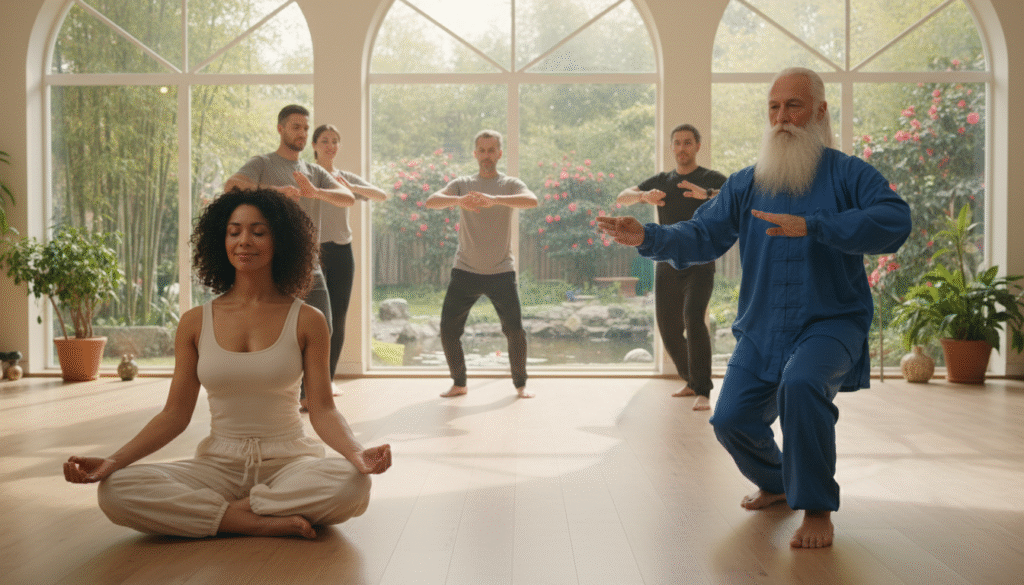
Tai Chi and Qigong are ancient Chinese practices that offer deep contemplative movement. Both focus on slow, flowing movements, deep breathing, and mental focus.
Tai Chi involves learning specific sequences of movements that flow like a slow-motion dance. Each movement requires focus on precise positioning while keeping an eye on your breath and internal energy. The slow pace makes it hard to rush through mindlessly.
Qigong focuses on gentle, repetitive movements, breathing techniques, and meditation. A simple Qigong exercise might involve raising your arms slowly while inhaling, then lowering them while exhaling, all while imagining energy flowing through your body.
Benefits I’ve experienced include:
- Improved balance and coordination
- Enhanced body awareness and proprioception
- Reduced stress through focused breathing
- Greater mind-body connection during other activities
If you’re new to mindful movement, start with Tai Chi or Qigong. Their slow pace and focus on breath make it easier to stay focused. Many community centers and parks offer free classes, making them easy to start.
Remember, the goal with these practices isn’t perfection—it’s presence. Start with what feels right to you, and be okay with being a beginner. Even five minutes of focused movement is more valuable than an hour of distracted exercise.
🏃 Creating Your Own Intentional Workout Routine
The most powerful fitness transformation I’ve experienced came from changing how I showed up for each session. Building an intentional workout routine means designing a practice that serves your whole self—body, mind, and spirit.
Mindful fitness planning isn’t about perfection. It’s about creating a framework that supports consistency while remaining flexible enough to honor what you need on any given day.
The beauty of this approach is that you become both the architect and the inhabitant of your practice. You design something uniquely suited to your life, your goals, and your values.
Setting Mindful Intentions Before Each Exercise Session
Before I begin any workout, I pause for just 60 seconds to set a clear intention. This simple practice has completely transformed the quality of my training sessions.
An intention is different from a goal. While a goal focuses on outcome (like running three miles), an intention focuses on the quality of presence you bring to the activity.
Here are some powerful intentions I use regularly:
- “I move to honor my body’s strength and resilience”
- “I stay present with each breath and movement”
- “I cultivate patience and compassion toward myself”
- “I exercise to create energy, not deplete it”
- “I connect deeply with my body’s wisdom today”
To set your intention, find a comfortable seated position before your workout. Take three deep breaths, inhaling through your nose and exhaling through your mouth. Ask yourself: “What do I want to cultivate during this session?”
Let the answer arise naturally. Speak it silently or aloud, then begin your practice with that intention guiding your awareness.
Incorporating Meditation into Warm-Ups and Cool-Downs
The transition moments before and after exercise offer perfect opportunities for meditation integration. I’ve found that bookending my workouts with brief mindfulness practices creates a complete, nourishing experience.
Here’s my simple 5-minute pre-workout meditation sequence:
- Minute 1-2: Sit comfortably and focus on your natural breath, noticing the rhythm without changing it
- Minute 3: Perform a quick body scan from head to toes, noticing any areas of tension or tightness
- Minute 4: Set your intention for the workout (as described above)
- Minute 5: Take three energizing breaths, visualizing yourself moving with strength and awareness
- Minute 1-2: Lie down or sit comfortably, allowing your breath to gradually return to its resting rate
- Minute 3-4: Scan through your body, acknowledging the sensations present after exercise with curiosity and appreciation
- Minute 5: Practice gratitude for your body’s capabilities and your commitment to showing up
These simple sequences support both physical recovery and mental integration. The warm-up meditation prepares your nervous system for activity, while the cool-down helps you transition back to daily life with greater calm.
Mindfulness meditation often involves sitting comfortably and directing attention to a chosen object, such as the breath, bodily sensations, or sounds.
Designing a Holistic Fitness Approach for Your Lifestyle
When I talk about workout design, I’m not just referring to exercise selection. A true holistic fitness approach considers how all aspects of wellness interconnect and support each other.
Your practice should include variety across several dimensions. Physical diversity means incorporating strength work, cardiovascular training, flexibility exercises, and balance challenges throughout your week.
But a holistic fitness approach goes deeper. It also addresses rest and recovery, stress management, nutritional support, sleep quality, and emotional well-being as essential components of fitness.
Here’s a framework I use to design balanced weekly routines:
| Fitness Component | Weekly Frequency | Mindful Integration | Example Practices |
|---|---|---|---|
| Strength Training | 2-3 sessions | Breath-focused lifting with intention | Mindful weightlifting, bodyweight exercises with awareness |
| Cardiovascular Work | 3-4 sessions | Present-moment awareness during movement | Mindful running, walking meditation, conscious cycling |
| Flexibility & Balance | 2-3 sessions | Body awareness and breath connection | Yoga, Tai Chi, stretching with meditation |
| Dedicated Meditation | 5-7 sessions | Seated or moving meditation practice | Morning meditation, body scans, breathwork |
| Rest & Recovery | 1-2 days | Active rest with gentle awareness | Restorative yoga, nature walks, gentle stretching |
Remember that your routine should fit your actual life, not some idealized version of it. I encourage you to start with what feels manageable and build from there.
Consider your work schedule, family commitments, energy levels, and personal preferences. The best routine is one you’ll actually follow, not the most ambitious one you can imagine.
Tracking Progress in Your Mindful Fitness Journey
Traditional fitness metrics have their place, but progress tracking in mindful fitness extends far beyond weight, reps, or speed. I’ve discovered that the most meaningful changes often happen in areas we don’t typically measure.
I track my journey using both objective and subjective markers. Physical metrics like strength gains and endurance improvements tell part of the story, but they’re not the whole picture.
Here are the progress tracking dimensions I monitor weekly:
- Body Awareness: How connected do I feel to my physical sensations during movement?
- Focus Quality: How present am I during workouts, on a scale of 1-10?
- Stress Levels: How effectively does my practice help me manage daily stress?
- Sleep Quality: Am I sleeping more soundly than before starting this approach?
- Emotional Well-being: What shifts have I noticed in my mood and emotional resilience?
- Consistency: How often am I showing up for my practice with genuine presence?
I use a simple journal format where I rate each dimension and note any observations. Finding just a few minutes each morning to dedicate to this reflection creates meaningful accountability without becoming burdensome.
You might also track how your relationship with exercise evolves. Do you approach workouts with more ease and less resistance? Are you enjoying the process more than you did before?
These qualitative measures reveal the deeper transformation happening beneath surface-level fitness changes. They show you’re not just getting stronger or faster—you’re cultivating a more integrated, aware relationship with your body.
The key is consistency in observation without judgment. Approach your progress tracking with the same curiosity and compassion you bring to your meditation practice.
⏰ The Best Times to Practice Mindful Fitness Throughout Your Day
Timing is key when mixing meditation and movement. But it’s not about strict schedules. Mindful fitness works best when it matches your natural energy patterns. Any moment can be a chance for awareness.
Your body needs different things at different times. What’s perfect in the morning might not work at night. It’s about finding flexible options that fit your life.
Start Your Day with Intention
Morning meditation and movement set a strong foundation for the day. If you wake up feeling foggy, starting with deep breathing and body awareness can clear your mind.
A 5-minute morning meditation can make you feel calm and focused. Some people find meditation before exercise helps them focus better.
Here are some morning combinations I love:
- Meditation followed by gentle yoga – A smooth transition from calm to movement
- Mindful breathing before a run – Makes your workout more meaningful
- Body scan during morning stretches – Connects with your body’s wake-up state
- Walking meditation at sunrise – Combines nature, light, and movement for training
Even short practices can settle your thoughts and improve focus. The fresh-start feeling makes mornings great for starting a daily routine.
Refresh Your Afternoon with Movement
The mid-day slump is real. Brief mindful movement can refresh you without the crash of caffeine or sugar. Between 2 PM and 4 PM, most people feel a natural energy dip.
Short awareness sessions during this time can boost your afternoon productivity. You don’t need a long gym session. Sometimes, just 10 minutes is enough.
Try these afternoon energy boosters:
- 10-minute walking meditation breaks around your building or neighborhood
- Desk yoga sequences in office clothes
- Brief breathing exercises at your workspace
- Mindful stair climbing instead of the elevator
These practices combine physical movement with mental reset. You’re not just moving. You’re also clearing your mind.
Wind Down with Gentle Evening Sessions
Contemplative movement in the evening helps transition from work stress to relaxation. Gentler practices later in the day help your nervous system adjust.
Restorative yoga, Tai Chi, or meditative stretching can close your day while improving sleep. Vigorous exercise might not be ideal close to bedtime, but gentle movement is perfect.
Evening practices I recommend include:
- Yin yoga or restorative poses held for 3-5 minutes each
- Slow-paced Tai Chi sequences focused on balance and breath
- Gentle stretching with conscious breathing
- Body scan meditation while lying down
The goal isn’t intensity. It’s awareness. You’re teaching your body to relax and prepare for rest.
Find Moments Between the Moments
Micro-mindfulness has changed how I see daily practice. You don’t always need dedicated time blocks. Bringing meditative awareness to everyday activities makes mindfulness accessible even when life gets busy.
I practice micro-mindfulness throughout my day in these ways:
- Conscious posture checks – Noticing how I’m sitting or standing every hour
- Breath awareness during commuting – Using drive time or public transit for breathing exercises
- Mindful stair climbing – Feeling each step instead of rushing
- Brief body scans between meetings – Taking 60 seconds to notice tension or relaxation
- Intentional transitions – Pausing mindfully when moving from one task to another
These small moments add up. Five one-minute practices throughout the day equal five minutes of meditation. It counts.
The beauty of this approach is flexibility. You’re not failing if you miss your planned session. You’re simply finding awareness wherever you are.
I encourage you to experiment with different timing options. Try morning meditation for a week, then test afternoon sessions. Notice how your energy responds. Your optimal schedule for awareness-based training might look completely different from mine, and that’s perfectly okay.
The best time for contemplative movement is the time that actually works for your life. Start where you are, use what you have, and build from there.
🔄 Overcoming Common Challenges in Body-Mind Connection Training
Mindful fitness isn’t always easy, and that’s okay. Everyone who starts body-mind connection training faces obstacles. These challenges don’t mean you’re doing something wrong.
Facing these difficulties is a natural part of the journey. I’ve experienced every challenge and learned valuable lessons. The key is to approach these obstacles with curiosity, not judgment.
The Wandering Mind Challenge
Your mind will wander during conscious movement practice. This is a common concern for beginners. They feel like they’re failing when their thoughts drift away.
A wandering mind doesn’t mean you’ve failed. Many think mindfulness means stopping your thoughts. But that’s not true. The goal is to observe your thoughts without judgment.
You’re not trying to make your mind blank. Instead, you’ll appreciate the calmness from observing your experiences, thoughts, and feelings without judgment.
It’s about noticing your thoughts without getting carried away. You learn to observe them like clouds passing in the sky. When your mind wanders during meditation, gently guide attention back to the breath without judgment.
I use specific anchor points to stay focused during my practice:
- The sensation of breath moving in and out of my nostrils
- The feeling of my feet making contact with the ground during walking or running
- The engagement of specific muscles during strength exercises
- The rhythm of my heartbeat during cardiovascular training
Noticing your mind has wandered and bringing it back IS the practice. Each time you return your attention, you’re strengthening your mindfulness muscle. I celebrate these moments instead of criticizing myself.
Managing Intensity Without Losing Awareness
Many people ask me how to stay present during intense workouts. When you’re breathing hard and your muscles are burning, staying mindful can seem impossible. I struggled with this when I first started my conscious movement practice.
Intensity and awareness aren’t opposites. You can push yourself physically while staying mentally present. High-intensity moments offer great opportunities for deep mindfulness.
Here are techniques I use to balance effort with presence:
- Breath counting during intervals: I count each exhale during high-intensity bursts, which anchors my attention.
- Body scanning during rest periods: Between sets, I quickly scan my body from head to toe, noticing sensations.
- Using discomfort as a focal point: Instead of mentally resisting the burn, I observe it with curiosity.
- Gratitude check-ins: I remind myself that physical challenge is a privilege, not a punishment.
The key is adjusting your awareness focus based on workout intensity. During easier moments, you can notice more details. During peak effort, simply staying with the breath is enough.
Time Management for Busy Lives
Time constraints are the biggest barrier for people starting a holistic fitness approach. I understand—modern life is overwhelming, and adding another practice seems impossible. I’ve juggled work, family, and personal commitments.
You don’t need hours each day. Even 5-10 minutes of mindful practice provides significant benefits. I’ve learned to integrate awareness into existing routines instead of treating it as something separate.
My favorite time-saving strategies include:
- Combining meditation with morning coffee: I practice mindful breathing while my coffee brews (3-5 minutes).
- Walking meditation during lunch breaks: A 10-minute mindful walk replaces scrolling on my phone.
- Mindful stretching before bed: This doubles as relaxation and body awareness practice.
- Conscious breathing during commutes: Traffic becomes an opportunity for presence instead of stress.
Let go of all-or-nothing thinking. Missing a day doesn’t erase your progress. Consistency matters more than perfection, and short practices done regularly create more change than occasional long sessions.
Working Through Frustration and Expectations
I felt frustrated during my first month of body-mind connection training. I expected immediate transformation and felt discouraged when I didn’t see dramatic results. Many people experience similar practice difficulties and give up too soon.
Unrealistic expectations create unnecessary suffering. We compare ourselves to experienced practitioners, expect linear progress, and judge ourselves harshly for perceived failures. I’ve learned that mindful fitness is a lifelong journey with natural ups and downs.
Process matters more than outcome. I now celebrate small wins: noticing my breath five times during a workout, choosing presence over autopilot for just one exercise, or recognizing a wandering mind without judgment. These moments accumulate into meaningful change.
| Common Challenge | Why It Happens | Practical Solution | My Personal Tip |
|---|---|---|---|
| Mind wandering constantly | Natural brain function | Use breath as anchor point | Celebrate each return to presence |
| Losing awareness during intense efforts | Physical stress demands attention | Count breaths during hard intervals | Make discomfort your focal point |
| No time for practice | Busy modern lifestyle | Integrate into existing routines | Start with just 5 minutes daily |
| Feeling frustrated with progress | Unrealistic expectations | Focus on process over outcomes | Keep a gratitude journal for wins |
Self-compassion has become my most valuable tool. When I notice frustration, I treat myself with kindness. I remind myself that every expert was once a beginner, and growth happens in spirals.
The mindfulness challenges you face aren’t obstacles blocking your path—they ARE the path. Each difficulty offers an opportunity to practice patience, self-kindness, and persistence. I’ve grown more from my struggles than from my easy days.
Remember that your holistic fitness approach will look different from anyone else’s. What works for me might not work for you, and that’s perfectly fine. Experiment with different strategies, trust your own experience, and give yourself permission to adjust your practice as needed.
📚 Resources to Deepen Your Mindful Fitness Journey
Finding the right meditation apps, books, and communities can really help. They turn your solo practice into a rich, supported journey. The tools and connections I share have helped me stay consistent and deepen my mindful fitness practice.
Whether you’re starting or expanding your practice, these resources offer guidance and inspiration. I’ve tried many, and these ones truly deliver.
Apps and Digital Tools for Meditation and Fitness Integration
Technology makes it easy to find top meditation apps on your phone. I use Headspace for its structured programs. It guides you from beginner to advanced meditation, with sessions for athletes and fitness enthusiasts.
Calm has beautiful nature sounds and guided meditations for post-workout recovery. I use it to relax after intense exercise.
Insight Timer offers thousands of guided meditations from teachers worldwide. It has sessions for mindful fitness and body awareness training.
When choosing apps, look for those that respect your privacy. Read their privacy policies and try free trials before committing.
Books and Podcasts I Personally Recommend
Books offer deep dives that apps can’t. “The Mindful Athlete” by George Mumford shows how meditation improved elite basketball players. It changed my approach to competitive fitness.
“Full Catastrophe Living” by Jon Kabat-Zinn is key for understanding mindfulness-based stress reduction. It’s not just about fitness, but foundational practices for any movement routine.
“Light on Yoga” by B.K.S. Iyengar combines practical yoga instruction with deeper wisdom. It’s a go-to for inspiration and technical guidance.
The “Rich Roll Podcast” features conversations with athletes and wellness experts. It’s great for commuting and gaining new insights.
“10% Happier with Dan Harris” offers practical meditation advice. His down-to-earth style makes mindfulness accessible to all.
Online Communities for Present-Moment Exercise Enthuasiasts
Connecting with others on similar journeys boosts motivation and accountability. Joining online forums dedicated to mindful movement is incredibly valuable. The Reddit communities r/Meditation and r/yoga are great for sharing tips and challenges.
Facebook groups focused on specific practices like mindful running offer personalized advice. Search for local meetups and practice partners in your area.
Many meditation teachers and fitness instructors have active communities on platforms like Discord or Mighty Networks. These spaces include live sessions, Q&A, and resource libraries. Feeling part of a community makes a big difference.
Having an accountability partner can greatly increase your consistency and enjoyment. Finding someone who shares your commitment is key.
Discover More Wellness Content on HealthyVibesLife.com
HealthyVibesLife.com offers a wealth of content for your wellness journey. We cover nutrition, stress management, and holistic lifestyle approaches.
Related Articles You’ll Love
If you liked this article, check out these related pieces on our site:
- Meditation Techniques for Beginners: A complete guide to starting your meditation practice with zero experience, including common mistakes to avoid and simple techniques you can use immediately
- Yoga for Stress Relief: Discover specific yoga sequences designed to melt away tension and restore calm, perfect for combining with your fitness routine
- Nutrition for Holistic Wellness: Learn how your food choices impact not just physical health but mental clarity and emotional balance, essential knowledge for anyone pursuing mindful fitness
Each article builds on the concepts we’ve discussed, giving you practical tools for better well-being.
Subscribe to Our Newsletter for Exclusive Health and Wellness Tips
Don’t miss out on valuable content for our newsletter subscribers. Join our community to receive:
- Weekly wellness tips and meditation techniques delivered straight to your inbox
- Exclusive wellness-related travel deals and destination recommendations for retreat experiences
- Early access to reviews of the latest fitness products and meditation tools
- Members-only workout routines and guided meditation recordings
- Special discounts on wellness courses and products I personally recommend
Our newsletter community has grown to thousands of health-conscious individuals. The content is carefully curated, never spammy, and always focused on helping you live your healthiest, most mindful life.
Subscribe today and start receiving content that will deepen your practice and connect you with like-minded wellness enthusiasts. I personally read every reply and love hearing about your journey.
✨ Real-Life Transformations Through Mindful Fitness and Awareness-Based Training
Seeing how meditation and movement work together changes everything. I’ve seen many people change their lives through this practice. These changes aren’t quick fixes but real, lasting improvements.
Everyone’s journey is unique. There’s no one right way to benefit from mindful fitness.
My Personal Journey with Mind-Body Exercise
My journey started from a place of struggle. I was stuck in a cycle of inconsistent exercise and body disconnection. I saw workouts as punishment, not celebration.
I was stressed out and overwhelmed. My job was demanding, and exercise felt like another task. My mind was always racing during workouts.
It all changed during a tough workout. I felt my anxiety physically. I stopped and realized I needed to listen to my body.
That moment led me to meditation. I started with just five minutes a day. It was hard at first, but I kept going.
Soon, I began to focus on my breath during workouts. I noticed how each movement felt. I started walking meditations instead of always running.
The changes were real:
- After six months, I looked forward to exercise
- My sleep improved in just eight weeks
- Chronic shoulder tension went away
- Exercise felt nourishing, not punishing
- I became more compassionate with my body
Today, mindful fitness is essential for me. It helps me manage stress and stay grounded. But I also have tough days. Now, I notice these moments and can redirect myself.
Inspiring Success Stories from the Community
Stories of change inspire me every day. Here are a few that stand out.
Maria, a 52-year-old teacher, found yoga and meditation after years of back pain. She practiced three times a week, focusing on body awareness. Her pain decreased by 70% in four months.
James, a 35-year-old software engineer, struggled with exercise consistency. But tai chi changed everything. He’s now consistent for over two years, seeing improvements in strength, focus, and anxiety.
Sarah, 28, battled depression and found mindful running helped her recover. Her morning runs became a moving meditation, improving her day.
These stories are real and inspiring. They show that mindful fitness can be a sustainable part of wellness.
What Research Shows About Long-Term Benefits
Research backs up the benefits of meditation and physical activity. The findings are impressive.
Sara Lazar’s Harvard study showed meditation changes the brain. People with years of practice had more gray matter in key areas. This is important because these areas shrink with age.
Beginners also see benefits. Lazar’s study found that daily meditation for eight weeks increased brain volume. These changes help with learning, memory, and emotions.
This research shows the power of mindful fitness. It combines neurological benefits with physical exercise for a strong synergy.
| Duration of Practice | Observed Benefits | Key Research Findings |
|---|---|---|
| 8 weeks (beginners) | Improved emotional regulation, better stress response, enhanced body awareness | Brain volume increases in hippocampus and other areas related to memory and learning |
| 6 months to 2 years | Sustained stress reduction, improved sleep quality, better pain management | Structural brain changes become more pronounced, improved immune function markers |
| 5+ years | Enhanced cognitive function, greater emotional resilience, maintained physical performance | Preserved gray matter, reduced age-related cognitive decline, lower inflammation markers |
Long-term practitioners see many benefits. They experience reduced stress, better focus, improved sleep, and emotional well-being.
Research also shows mindfulness helps with mental health. It improves anxiety, depression, and PTSD.
Physical health also benefits. Mindful fitness helps with pain management and may improve the immune system. Cardiovascular health can also improve.
Mindfulness meditation can change the brain, even in short time frames. It affects learning, memory, and emotions.
The benefits of mindful fitness grow over time. Even beginners see improvements quickly. The practice is cumulative, leading to lasting changes.
This research supports my own journey and others. Mindful fitness is about lasting changes in brain and body function. It’s a scientifically-backed way to improve health and well-being.
Every person’s transformation is unique. Whether you seek physical healing, mental clarity, or emotional balance, mindful fitness offers a path. The research and stories confirm it, one mindful movement at a time.
🎯 Conclusion
I think the beauty of a holistic fitness approach is simple. You don’t need fancy equipment or lots of free time. What’s key is being aware of your movements and breathing.
Your mindful fitness journey begins with a single conscious breath during your next workout. This turns regular exercise into something more profound and meaningful.
Studies show mindfulness has been around for thousands of years and is backed by modern science. It helps reduce stress and boosts focus. These benefits aren’t just for the gym.
I suggest trying one practice from this article this week. Start with just five minutes of focused breathing or a short walk. Small steps lead to lasting habits.
Wellness integration isn’t about being perfect. It’s about being consistent and kind to yourself as you find what works for you.
Visit HealthyVibesLife.com to find more wellness strategies and join our community. I share tips, stories, and science-backed advice to help you grow.
Your body and mind are ready for this change. The only question is: which mindful practice will you start today?